What to know
- Legendary rock photographer Bob Gruen has more than 100 photographs on display at Toronto’s Liss Gallery through Oct. 10, including 36 works newly printed from his archives.
- Gruen is behind some of rock’s best-known images, including John Lennon in a sleeveless New York City T-shirt and Led Zeppelin beside their plane.
- He tells NOW that the rise of smartphones has transformed music photography because artists can no longer control their image the way they once could.
- His advice to aspiring photographers? Take lots of pictures, understand the music — and only show people your best ones.
- Gruen also has a new Debbie Harry and Blondie photo book coming in April 2027.
John Lennon wearing a sleeveless New York City T-shirt on his rooftop; Led Zeppelin standing beside their airplane—these are among rock’s most iconic images. The man behind the lens was Bob Gruen, whose 61-year career also included environmental portraits and candid snaps of rock royalty, such as David Bowie, Blondie, The Rolling Stones, Tina Turner, the Ramones, the Sex Pistols, and KISS.
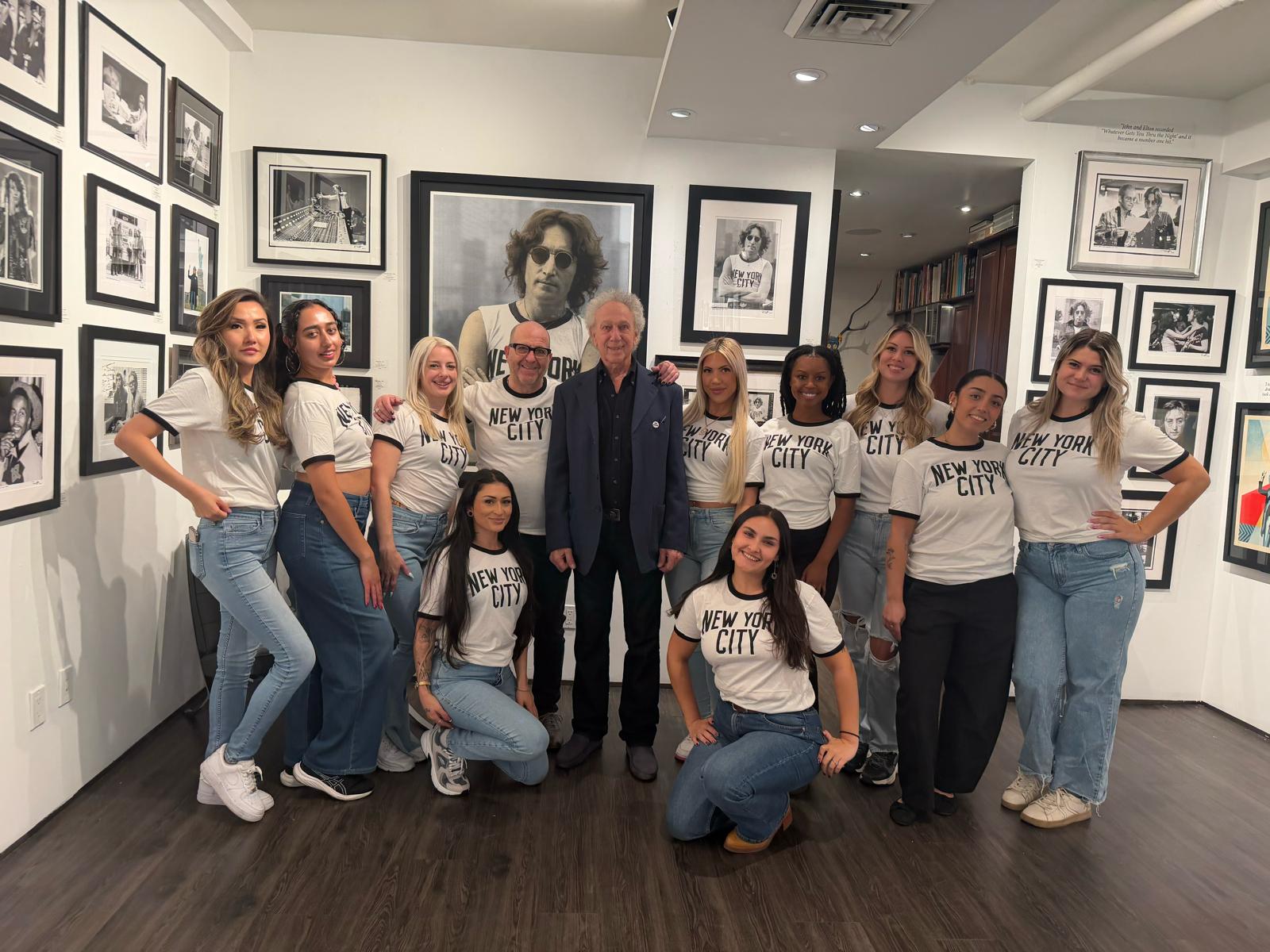
Yorkville’s Liss Gallery, owned by Brian Liss, hosted Gruen over the weekend to launch his latest exhibit, which will remain on the walls until Oct. 10. For sale are about a hundred photographs, including 36 newly printed works from his enormous archives.
Gruen has exhibits all over the world, including in Italy, Ibiza and London, as well as New York, where he was born — and where he took his iconic Lennon photos.
He doesn’t shoot much anymore. He tells NOW that he spent two days on the set of the film Tony, directed by Toronto’s Matt Johnson, about Anthony Bourdain’s early days, making photos that have appeared worldwide. He also did a shoot in 2023 for Italian rockers Måneskin, and a cover in 2024 for Downtown Magazine NYC with Nile Rodgers and Lenny Kaye.
Besides exhibits, Gruen is focused on publishing. He has several books coming out, including one on Debbie Harry and Blondie, due in March; a new edition of his monograph, Rock Seen, next fall; and reprints of both his autobiography, Right Place – Right Time, and John Lennon – The New York Years, later this year.
Gruen sat down with Karen Bliss when he was in Toronto to talk about his most iconic photo, his proudest pic, why he likes shooting people, the phone camera era, and what it takes to shoot a musician now.
You’ve had exhibits at Liss Gallery before. This one is different because 36 have never been printed before.
He’s got over 100 pictures on the wall. I’ve had a lot of exhibits, but I was very impressed when I walked in the gallery, there were so many pictures, like three rows, the whole length of the gallery. He’s picked a whole bunch of pictures that haven’t been made before. For instance, there’s a picture I’ve had of Elton John and Stevie Wonder on a plane, but he found another one taken an hour later, where they’re sitting in the dressing room chatting. So, a number of pictures from similar sessions that we hadn’t printed before. At the time, when we take them, you pick a good one and you go on, but now we’re going back to look at those, and there’s loads of other good ones on the same roll.
How big are your archives?
I’m a pack rat. I didn’t throw anything away and I never moved, so I never put anything in my grandmother’s garage. I have everything that I collected, every picture, every magazine that my pictures have been in, every book, and it started to fill up our apartment, so we now have three storage rooms full of stuff. My wife, Elizabeth, has spent the last 12 years organizing the archives. Elizabeth spent 25 years in the fashion business and then realized she had accomplished her goals in fashion, and my archive needed to be organized, and so we are now very organized.
So, I could say, “Do you have a photo of so-and-so from 1977?”
I can ask for a photo or a videotape, or a book, we have it all in a program, so she can look it up and tell me exactly what box, and what shelf, and which storage room. She knows where everything is. I don’t know where anything is.
If you have an entire book coming out of Debbie Harry and Blondie, how many shoots did you do with them over the years?
From ‘74 to ’25. It’s over 50 years that I’ve known Debbie. The latest picture I think is 24. We did an interview in June, ’26, that’s new. But I think the latest picture we had to edit a bit. It was for 50 years from when I met her, she was in the Stillettoes, and then they formed Blondie. And then over the years, after the 80s, Debbie does all kinds of different things. She’s very generous with a lot of charities. And, being in the city and being friends with Debbie, you just have all these different pictures of different places. You can’t take a bad picture of Debbie. She just came out into the world beautiful. She’s a very cool girl, very punky, very smart.
Would you ever come back to Liss with a Debbie-only exhibit?
Well, we talked about that possibly in the spring, when the book comes out, we might have a big Debbie show. She’s kind of like the Marilyn Monroe of our generation and they do have Marilyn exhibits. So, we might have a Debbie exhibit.
What do you like about working with musicians versus shooting landscapes or objects?
I find people fascinating. The more different they are, the more fascinating to me. I love meeting interesting people. I like landscapes and sunsets, but people are fascinating, and they’re all so uniquely different. I’m just thoroughly amused by meeting people.
And, to be clear, you’re still shooting musicians because you did Måneskin in 2023.
When they came to New York, they’d grown up looking at my pictures, and they wanted to meet me and do a photo session. I don’t do a lot of sessions nowadays, certainly not like I used to because I don’t have the same contacts, and the whole style of media has changed a lot. When I took pictures back then, you would develop a film overnight and get prints the next day and send them out by DHL, and, now, before the first song is over, people are distributing the picture around the world with a few touches on the phone.
You had amazing access to artists back then. Then it became more restrictive. Photographers were rarely allowed backstage, and at shooting concerts had a “first three songs” rule. Then came camera phones and no one can control photos [unless they’re locked in Yondr pouches, like Jack White does].
In the 70s, rock and roll started becoming a good business, and by the 80s, corporations started taking over, and they wanted to control everything. So, they started restricting the access to photography to try to control their image. For a while, in order to take pictures, you needed a photographer, somebody who actually had the camera, and knew how to operate it, and knew how to develop and print the pictures, which was a whole process. Now, you don’t need to know anything. You just touch your phone once, and you’ve got a printable picture. The phone does all the work for you. It’s very difficult to control an image nowadays when everybody has a camera.
What’s your view of Photoshop?
I feel Photoshop can be really useful for the old pictures that we have that weren’t exposed properly. Photoshop is brilliant to be able to enhance a photo. I don’t change pictures. We don’t create pictures by AI or anything like that, but we do use Photoshop to enhance. It’s like printing in the darkroom; you bring out certain areas that were darker or lighter. I find that to be really helpful.
Given that everyone takes photos on their phones these days, what would you say to young people who want to become professional photographers, particularly those interested in photographing musicians?
Don’t give up the day job [laughs]. I think one reason I got such good pictures is because I like the music, and I can feel the music, and I’m into it, and I know when to capture a climax kind of moment. You have to anticipate that. You can’t take a picture after you see it. You have to anticipate before it happens to be in the right place at the right time and because I really enjoy the music, I’m able to anticipate that. As far as young people wanting to go into photography, I found it to be a lot of fun, and it gave me a lot of access. But there’s a lot of competition, particularly nowadays since everybody can take a picture. One bit of advice I tell people is to take a lot of pictures, and you’ll probably get a couple of good ones. And if you only show the good ones, people will think you’re good. One of my pet peeves is people who put a hundred pictures up and say, “Look what I did last night.” Just put one.
If a band who really loves your work wants to hire you for a promo or album cover shoot, what would it take for you to say yes?
A fee. Pay me. I’m easy. I don’t judge people. I’ll take pictures of just about anybody for a budget.
The photo I use on my socials is of me wearing a New York City t-shirt, a nod to your iconic Lennon photo. Do you think that’s silly or are you flattered?
It worked for me. Those shirts were made by some guys, I wish I knew who they were, but they were from Brooklyn or Bronx or something. They came into the city and had a blanket on the sidewalk, and they were selling them on 44th Street and 7th Avenue. And when I saw them, I liked the graphic. It was very powerful, the font, the style of type. It was very simple, but there’s something very powerful about the phrase New York City. Those three words represent the idea of freedom and power, and you can invent yourself. When people see New York City, it’s different than seeing St. Louis or Des Moines. They don’t mean anything. But New York City, around the world, has a power to it. So, I bought some for myself. And after I got the first one, I liked it so much I went back. I bought a four more; I bought two more. I ended up with a half a dozen or eight of them because I used to wear it every day. I was changing in my shirt every day. And then I started buying them for my friends.
And one night. when I was on my way to go see John in the studio, the guys were on the sidewalk, so I bought one. I cut the sleeves off with my Buck Knife and I gave it to him. And he liked it enough that I took a picture of him wearing it a year later. Because I gave it to him one night in August of ‘73. And then he had what’s called The Lost Weekend, where he went out to Los Angeles and got it loaded and had some wild nights. And then, we were taking pictures in the summer of ‘74 for an album cover picture. And then after we did the portraits for the album cover, I said, “Do you still have that shirt I gave you?” He was on the roof of his penthouse apartment, and I said, “The skyline would make a great picture with this shirt.” And he knew right where it was and he went and got it. So, that convinced me that he liked it. A lot of people gave him a lot of things that didn’t really stay with him and the fact that he had that, I knew he liked it. We had no idea when we took it that it was going to be such a popular picture.
Out of all your work, is there another one that stands out for you, that you’re most proud of?
Actually, it’s another picture of John Lennon. One of my favourites is a picture of John at the Statue of Liberty. It’s one of the few pictures that I suggested a certain spot. Usually, I just show up and make the best of it. But for that picture, I suggested to him that we go to the Statue of Liberty and take a picture because the U.S. government was trying to throw John out of the country, trying to have him deported because he was talking about peace in a time of war. And the government felt that he was hurting the war effort by talking about peace. President Nixon was afraid that it would influence the votes, so he wanted to deport him and I felt that the Statue of Liberty was a symbol that we should be inviting people like John Lennon to America. And he agreed. So we took that picture, which, to me, is one of my most important pictures because, for me, John Lennon represents personal freedom.
And for me, you see, rock and roll is all about freedom. It’s about the freedom to express your feelings very loudly and publicly. It’s all about that moment when everybody’s screaming, “Yay!” and nobody’s thinking about paying the rent. Everybody’s just in the moment and ecstatic. Those are the moments I like in a picture. And those are the moments I try to capture in my photos so that I’m not just capturing the facts of what colour shirt the guy’s wearing, but I want to capture that moment of passion, that moment of feeling. I’m very happy when people see a photo of mine and they say it feels like they’re there, like they can feel that moment.