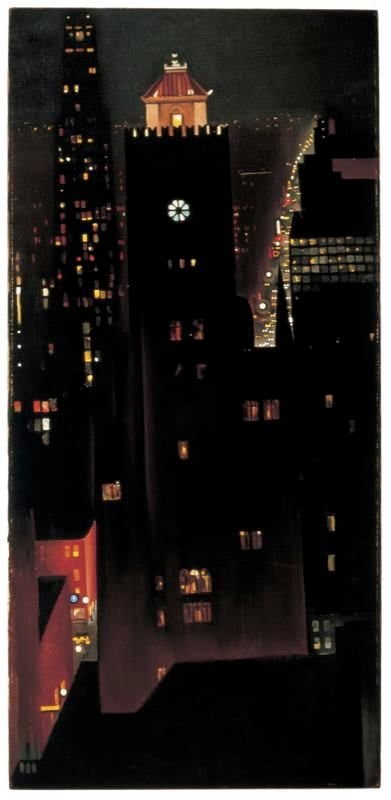
GEORGIA O’KEEFFE at the Art Gallery of Ontario (317 Dundas West), to July 30. $25, stu $16.50, srs $21.50. ago.net. See listing.
Georgia OKeeffe is a contradictory figure: an icon who denied that her biography was of any importance, a painter whose images were famously seen as sexual who rejected this interpretation, a woman who succeeded in the art world but refused the designation woman artist, a loner whose work has achieved wide popularity.
Hers was a unique career trajectory, evidenced by the shows 80 works, exhibited chronologically. While 20th century modernists usually began with representational art and eventually evolved toward abstraction, OKeeffe (who was born in 1887) seemed to emerge more or less fully formed around 1916. In that year, a friend sent abstract drawings by OKeeffe, then working in Texas as an art teacher, to Alfred Stieglitz, the New York photographer and gallerist who became her husband and promoter. She continued to toggle between abstraction and realism throughout her life.
As contemporary Canadian artist Maria Hupfield points out in one of the videos commissioned to accompany this spring’s retrospective at the AGO, changes in OKeeffes style and palette are more deeply related to her interaction with the environments she inhabited electric lights glowing against grey New York City, the lush greens and blues of upstate New York, the red and yellow ochre of New Mexican deserts than with a temporal progression.
OKeeffe laboured always to refine and simplify the forms she was drawn to, be they geological features of the landscape, architectural details or fragments of nature like flowers, leaves and bones. Her paintings have a definite intensity, yet her smooth, flat painting style, like that of Lawren Harris, can come across as stark, designy and without passion, especially when you compare her to more expressive 20th century women we treasure like Frida Kahlo or Emily Carr. Reproductions of her works, the flower paintings in particular, are favourites for interior decor and have led to overexposure.
Then theres the question of OKeeffes persona. The show includes examples of the many photographs Stieglitz made of his beautiful beloved, who served as object of the male gaze while at the same time trying to achieve her own agency. No wonder the human figure never appears in her work. Stieglitz supposedly popularized the Freudian notion of her flower paintings and abstractions as vaginal images. She made the best of the no-win situation facing her as a woman and continued on her own path.
The Brooklyn Museum, the first institution to give her a solo show, is currently exhibiting some of OKeeffes clothing alongside her paintings. A dramatic dresser, she seems to have been an early adopter of the all-black wardrobe now de rigueur in the art world. The Brooklyn show suggests she carefully crafted her diva persona just as she did her art.
OKeeffe was still alive when Judy Chicago showed The Dinner Party in the late 1970s. I cant find any comments by her, but I wonder what OKeeffe made of being honoured as the final woman to get a place at the table, her plate a swirling purple vagina. Was she horrified or privately amused?
art@nowtoronto.com | @FranSchechter