What to know
- Sasha Velour’s Travesty brings centuries of Queer history to the stage through drag, storytelling and theatrical spectacle.
- The 90-minute show takes place in a haunted theatre, moving through Queer history from the 1880s to the 1980s.
- Expect 12 costume changes, seven projection surfaces, lip-sync, comedy, tragedy, projection mapping and elaborate lighting.
- Travesty hits Toronto’s Elgin Theatre on Oct. 2 as part of Just For Laughs Toronto, with tickets on sale now.
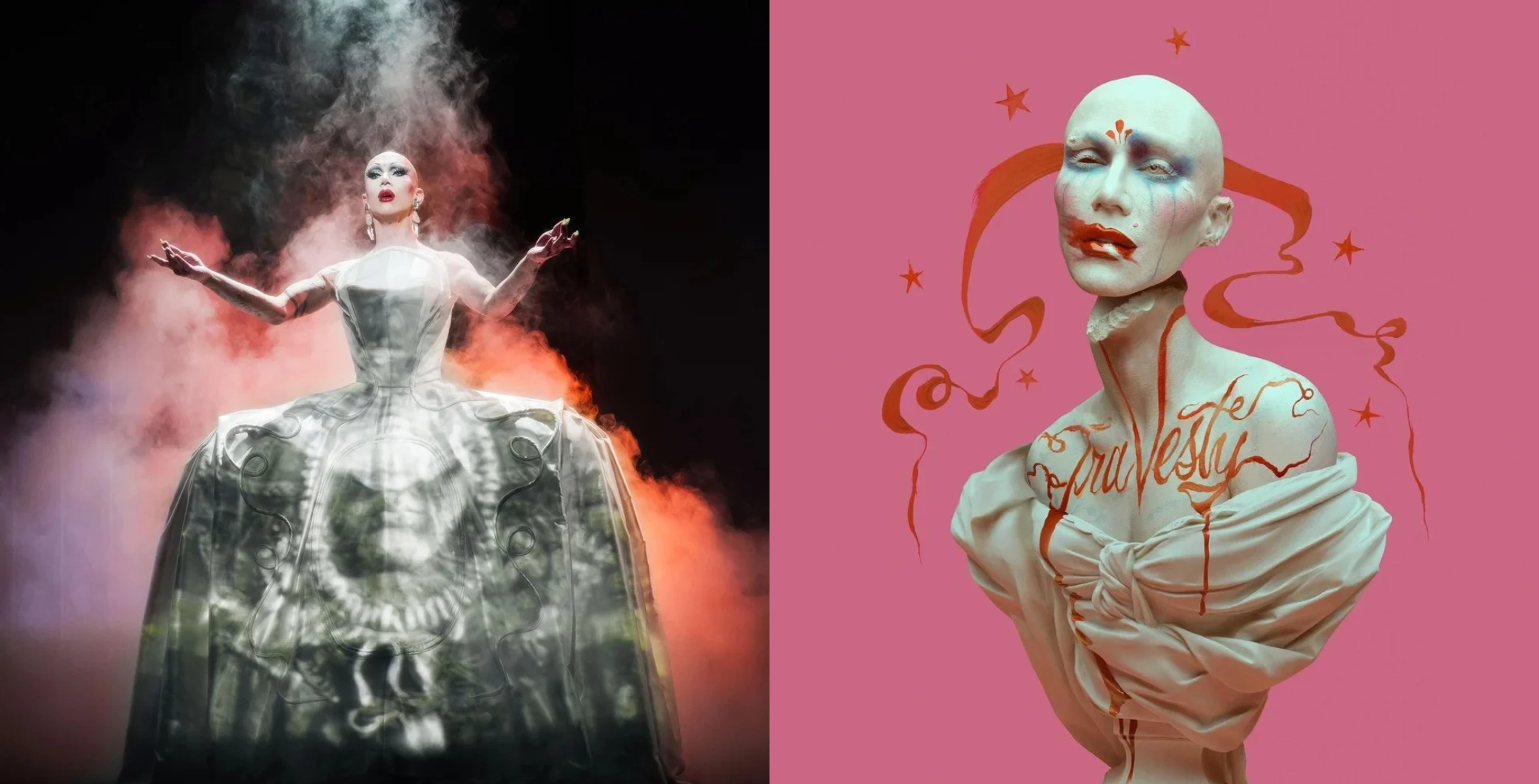
What if a haunted theatre could tell the story of Queer history? That’s the premise of Travesty, the latest one-queen theatrical spectacle from drag superstar Sasha Velour.
Just for Laughs is taking over Toronto with a killer roster of shows from Sept. 24 – Oct. 3, featuring some serious talent, including Sasha Velour, winner of RuPaul’s Drag Race season nine. Velour’s one-woman show Travesty takes audiences on a genre-defying journey through Queer history, focusing on drag and acts of resistance.
Rather than treating Queer history as something that can only be documented and learned through textbooks and archives, Travesty puts it onstage, melding iconic lip-syncing, camp storytelling, luscious costumes, and beautiful projection and lighting into a theatrical spectacle unlike anything you’ve ever seen before.
Travesty: A journey through Queer history
The show, which runs just under 90 minutes, is set in a haunted theatre, moving through different eras of Queer history, from the 1880s through the 1980s, with the queen embodying a series of characters as the theatre itself changes around them.
The result is a gripping tale combining the structure of a ghost story with the facts of a history lesson and the spectacle of drag. Velour explained that the combination is intentional.
Growing up in Brooklyn, New York, Velour explained that the local diverse drag scene helped shape her understanding of gender freedom and expression. That included seeing performers who challenged traditional gender binaries, as well as drag kings and other artists who expanded what drag could look like. Learning about the history of drag also encouraged them to take the stage.
“It took me a while to learn about the history of drag. The idea that this is not only dressing up and transforming your gender wasn’t just an amazing work of art and super fun for people to watch, but it could be something kind of political and boundary-breaking as well,” she told Queer & Now.
“Learning about the history of the Stonewall uprising and how drag queens and drag kings have been at the forefront of advocating for visibility and for equal rights for our entire community. That is what really resonated with me and made me want to put on a wig and stand on the stage and hold a microphone and tell my story, and so that’s what brought me to the Brooklyn drag scene.”
Their own relationship with drag began early.
“As soon as I had language to describe articles of clothing, I wanted to be wearing high heels, wigs, gowns,” she explained. “I had a fantasy of something fabulous for myself and for fashion that I didn’t see around me.”
“I started making things out of scarves and wearing pantyhose on my head as a wig, always innovating with beauty.”
That innovative, creative spirit eventually led to the creation of a homemade drag zine, with Velour’s work eventually expanding to NightGowns, an experimental New York drag revue which has been running for 11 years. The queen explained that the show quickly became an important part of her artistic practice and helped lead to their casting on RuPaul’s Drag Race season nine.
Sasha Velour: RuPaul’s Drag Race to Just for Laughs
Speaking of their experience on the hit drag competition series, Velour says her now-famous lip-sync performance and rose-petal reveal became a defining moment in their career, one that helped inform the visual language of Travesty.
But Travesty is bigger than a collection of drag numbers. The show’s creator and star describes the production as a means of making 2SLGBTQIA+ history accessible, particularly for people who might not otherwise see themselves in traditional theatre, dance or performance art.
The star explained that her new production uses a handmade miniature theatre that is filmed and projected onto a larger scale. Throughout the performance, the theatre ages, falls apart and transforms, with imagery including fire, water, neon signs, billboards and graffiti. It’s a fitting visual metaphor for the history Velour is exploring: Queer-dedicated spaces have disappeared, been threatened and been rebuilt, but the stories and the people who created them remain.
The show also draws from Velour’s research for The Big Reveal, their 2023 book exploring 2SLGBTQIA+ expression in performance art. While Travesty reaches back through that expansive, delicious history, Velour says drag remains very much connected to the present.
The performer sees drag as more than entertainment. It can be a place that welcomes people to the community, provides mutual aid, and gives insight into Queer-history, culture and resistance, particularly at a time when opportunities for Queer performance are becoming more limited.
That ethos extends beyond the stage. NightGowns has also been used as a platform for fundraising and mutual aid, including support for immigration initiatives, people facing ICE detention and people in Gaza.
For Velour, drag isn’t simply about putting on a costume and performing a song. It can be a way of remembering, building community, and imagining what comes next.
“I think about how going to a drag bar for the first time changed my life and changed my sense of the world,” she explained. “I had never been to a place that really practiced the idea that every person could be welcome, and cultivated a space where people were encouraged to be free to look like themselves, and treat each other with respect.”
He explained that while that bar has since closed its doors, she tried to carry that spirit throughout their work.
“I try to… make sure that my shows are a place where people are welcome and where they feel joy and freedom. Maybe it starts on the personal level, but the values that I learned from drag about tolerance, about love… are like now my belief system; that is how I operate in the world.”
Through Travesty, she invites audiences to experience Queer history not as a distant collection of dates and names, but as something that has been performed, fought for, celebrated and passed from one generation to the next.
“There’s a way that the arts can be very political, and I think that is something that drag takes very seriously. Even though when you come and see the show, it’s just beauty, it’s just fun, it’s a story,” Velour continued.
“There’s always a political dimension for those for whom that’s important. So that’s what I say when I mean change the world,” she added, referring to the description of her show, as well as her famous line following her Drag Race win in 2017.
The Toronto show will feature 12 costume changes across seven projection surfaces, combining comedy, tragedy, lip-sync, projection mapping, lighting, costume and sound design into one theatrical experience. From RuPaul’s Drag Race winner to internationally acclaimed performance artist, Velour is bringing that history to the Elgin Theatre, one number at a time.
Travesty runs Oct. 2 at the Elgin Theatre as part of Just For Laughs Toronto 2026. Tickets are on sale now through HAHAHA.com, with VIP upgrades including a pre-show meet-and-greet and commemorative lanyard.