
One Toronto Lesbian couple reminds us of how far Queer rights have progressed in the last 30 years.
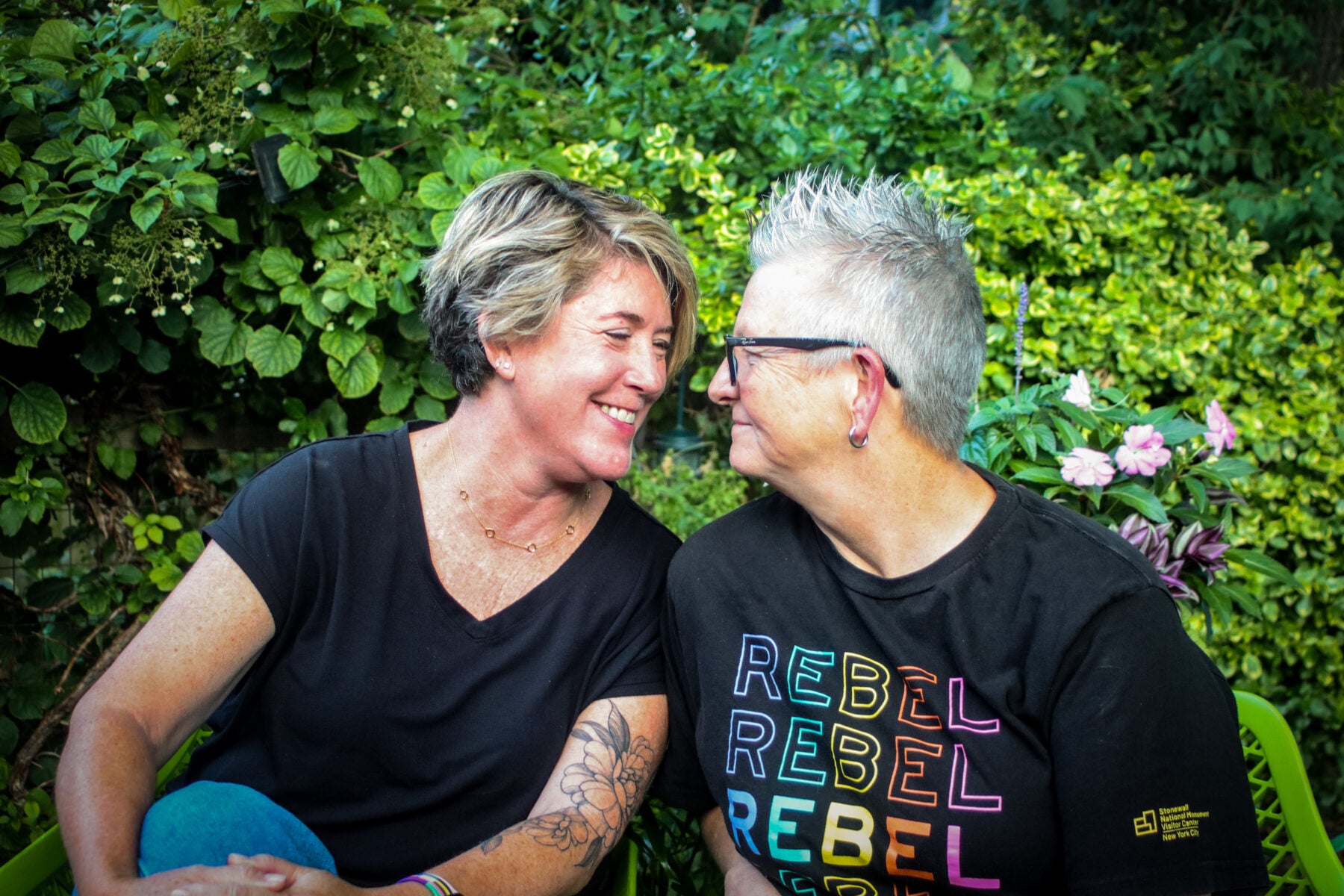
Sitting across from Heather Jamieson and Christine Allen in their Toronto home, it’s immediately obvious they’ve spent decades together. In fact, now in their 50s, the wives have been together for more of their lives than they spent apart. They finish one another’s stories. They interrupt to correct tiny details before laughing about who remembers it properly. Thirty years on, conversation between them has become its own language.
They describe their relationship as one that is typical of two people, no matter their sex or gender, in love. They’ve been married for decades, share two children, own their home, met in their 20s and soon decided that they had met their match. But in the context of being a Lesbian couple, their story traces nearly every major milestone in modern Canadian Queer history. First finding one another before dating apps, then holding a commitment ceremony years before same-sex marriage became legal, navigating parenthood without legal protections for both mothers, and watching rights they once fought for become ordinary for younger generations.
Heather & Christine: Guelph, 1996
We first met during Green Space, the annual Pride fundraiser for The 519 community centre at Church and Wellesley, with Allen sharing that she and Jamieson were celebrating their 30th Toronto Pride as a couple. But that’s not where their story begins.
Welcoming me into their kitchen, the wives showed me a Toronto Pride poster from their first parade as a couple, back in 1996. Back then, Allen was a student, a senior at the University of Guelph who was part of the Women’s Resource Centre collective on campus. Jamieson was a young nurse who sometimes hung out with her roommate, who was also a Guelph Student, on campus. One day, while walking on campus, Allen spotted Jamieson on the steps, and she had only one thought.
“She’s a Lesbian. I have to know her,” she laughed during an interview with Queer & Now.
It’s a feeling many Queer people of a certain generation, or perhaps of every generation, know intimately. But especially before the rise of dating apps, predating algorithms and rainbow profile pictures, finding another 2SLGBTQIA+ person in the wild (or at least the cities and towns…) could feel like finding a stream in the desert. Because of this, many Queer people have developed signals and signs to indicate their identity to other community members. But sometimes all it takes is a glance to know that you’d found someone who understood your world.
Thirty years later, Heather and Christine are still finding each other.
This summer marks 21 years since marriage equality became law in Ontario, but by the time the legislation caught up, Heather and Christine had already built a life together. They had already exchanged vows and started the process of building their family. The law simply gave legal recognition to a commitment they had made years before.
Read More
Like many Lesbian love stories, theirs began quickly.
Meeting through mutual friends at the Women’s Resource Centre, they soon went to a Queer bar in nearby Kitchener, exchanging phone numbers and planning a date. While Allen was openly dating someone else, she soon realized that she only wanted to be with Jamieson, and the way she describes that moment sounds like something out of a film.
Visiting Montreal with friends, she realized she wasn’t immersed in the concert she’d come to see, she was homesick, but not for Guelph. For Jamieson. She cut her trip short, calling Jamieson to let her know she was getting on a bus home. When Allen arrived, she found her girlfriend waiting for her, standing in the rain underneath a streetlight, shielding Allen’s teddy bear with her yellow rain jacket.
“I think 30 years later, that’s pretty much why I’m here,” Allen smiled.
That first Toronto Pride together in 1996 became another milestone in their whirlwind romance, and Toronto’s Queer history. The couple joined thousands of others in the inaugural Dyke March, an event created to centre Lesbian visibility and activism within Pride.

For Allen, who had spent years believing she was “the only Gay person on the planet,” marching through Toronto alongside other Queer women was both exhilarating and affirming.
“To have something organized like that and to be part of that is pretty spectacular,” she recalled.
Three decades later, Pride still holds that same significance. Returning year after year, Heather and Christine have watched the celebration grow from a grassroots demonstration into one of the largest Pride festivals in the world, while carrying memories of a time when simply finding another Lesbian could feel impossible.
This summer marked their 30th Toronto Pride together, a milestone that mirrors the evolution of Queer rights in Canada. Yet for them, Pride has never only been about how much has changed. It’s about celebrating the community that existed long before legal recognition, and the people who built spaces where 2SLGBTQIA+ love could thrive while the rest of the world struggled to catch up.
Queer marriage before marriage equality
Months after becoming exclusive, they were engaged. Explaining the quickness of the commitment, Allen shrugs, “We’re Lesbians.”

At first, there was no elaborate proposal. Instead, sitting in the university library, they discussed the idea on the internal computer messaging system. Soon after, Jamieson planned a date at a local restaurant; Allen wore a “pretty dress” and was proposed to with rings that Jamieson had engraved. Allen’s bears that date, November 2, 1996, while Jamieson’s sweetly reads “she said yes.”
Beginning 1997, Allen, then 23, and Jamieson, then 27, were happily engaged. Allen had graduated, and the two were living together and planning their nuptials. The only caveat, of course, was that in the late 1990s two women couldn’t legally marry in Canada. Or anywhere else, for that matter. But, as Rev. Dr. Cheri DiNovo once told Queer & Now, our community has been getting hitched for longer than the law has recognized.
In 1998, the couple organized a commitment ceremony that was executed almost entirely through community effort. Friends coordinated a potluck reception, and local musicians volunteered their talents. Buckets of flowers were brought in from the local market, and they rented an outdoor community space for $20.
“People were proud… There were not a lot of gay people there…” Jamieson explained. “But I think people were really proud to be part of it.”
Everyone stood together in a circle as an Anglican priest, performing one of her first ceremonies for a same-sex couple, led them through vows they had written for one another. Looking back, Christine laughs at the language they used.
“We called it a commitment ceremony,” she explained, “In hindsight, it was a wedding.”
Today, same-gender couples in Canada can marry without legal barriers that once made the word “marriage” feel unrealistic. Something that is still inaccessible in the majority of the world, with less than 40 countries around the world recognizing Gay and Lesbian marriages. Jamieson and Allen are a warm reminder that 2SLGBTQIA+ never waited for governments to validate our lives; we live them anyway.
Jamieson and Allen’s love fosters a resilience that carried them through the initial rejection of Jamieson’s parents, who skipped their commitment ceremony because of their religious beliefs. Years later, after painful conversations and time apart, they found their way back to one another and rebuilt a loving relationship as they created their own family. Jamieson explained that her mother chose a relationship with her daughter over rigid interpretations of faith. When grandchildren arrived, healing followed.
From newlyweds to mothers
That same resilience carried them through the complicated journey of becoming mothers as a Lesbian couple in the early 2000s. This was a time when starting a two-mom family meant having no option but navigating systems that weren’t built for them.
“We did the Dykes Planning Tykes course that was run through the 519,” Jamieson shared. “Back then it was… I don’t want to say cutting edge, but there just were not a lot of Queer services for people wanting to become parents.”
Fertility services for Lesbian couples were virtually nonexistent, and becoming parents required years of trying, the generosity of a friend who became a sperm donor and, later, expensive legal processes so Jamieson could adopt her own children. They explained that this was because she was not eligible to be added to their birth certificates at the time, as Allen was the mother who carried the children.
Even after their sons, who are now 18 and 21, were born, they travelled with adoption papers in hand in case anyone questioned whether both mothers were really parents. Many of those barriers have since disappeared.
30 years of progress
Today, two mothers can both appear on a birth certificate from the beginning. Fertility care is more accessible. Younger Queer couples have options that newly married Allen and Jamieson never could have imagined in the late 1990s.
Progress, however, has never been linear. Jamieson still remembers strangers yelling slurs as the couple walked hand in hand. Even now, they instinctively assess whether a space feels safe before deciding whether to show affection in public. That almost involuntary calculation is one many 2SLGBTQIA+ people still make every day.
As we celebrate another anniversary of marriage equality, it’s easy to frame progress through legislation, court decisions and political victories. But sitting across from the wives, one thing became clear: Queer history, Queer progress, is also built from ordinary acts of devotion.
A first phone call after meeting at a bar. A teddy bear protected from the rain. Friends carrying flowers and food into an outdoor venue because two women in love deserved a wedding just like any other couple, even if the law refused to call it one.
Thirty years after they first found each other, Allen and Jamieson still renew their vows every five years. Sometimes with a party, sometimes at the kitchen table over beverages. Never because they have to, but because they always want to.
Their officiant, a woman named Lucy, explained that when they first promised “in sickness and in health,” as young brides, they, like all newlyweds, had no idea what was in store. But three decades later, after illness, kids, careers, the deaths of loved ones, and everything else life throws at you, that’s when those vows really mean something.
“I think as you move through committed relationships, there are ebbs and flows, and you have to make a conscious choice to choose the person you’re with,” Jamieson explained.
So every five years they stop and consciously ask, “Are we still choosing each other?”
And the answer is always yes.


