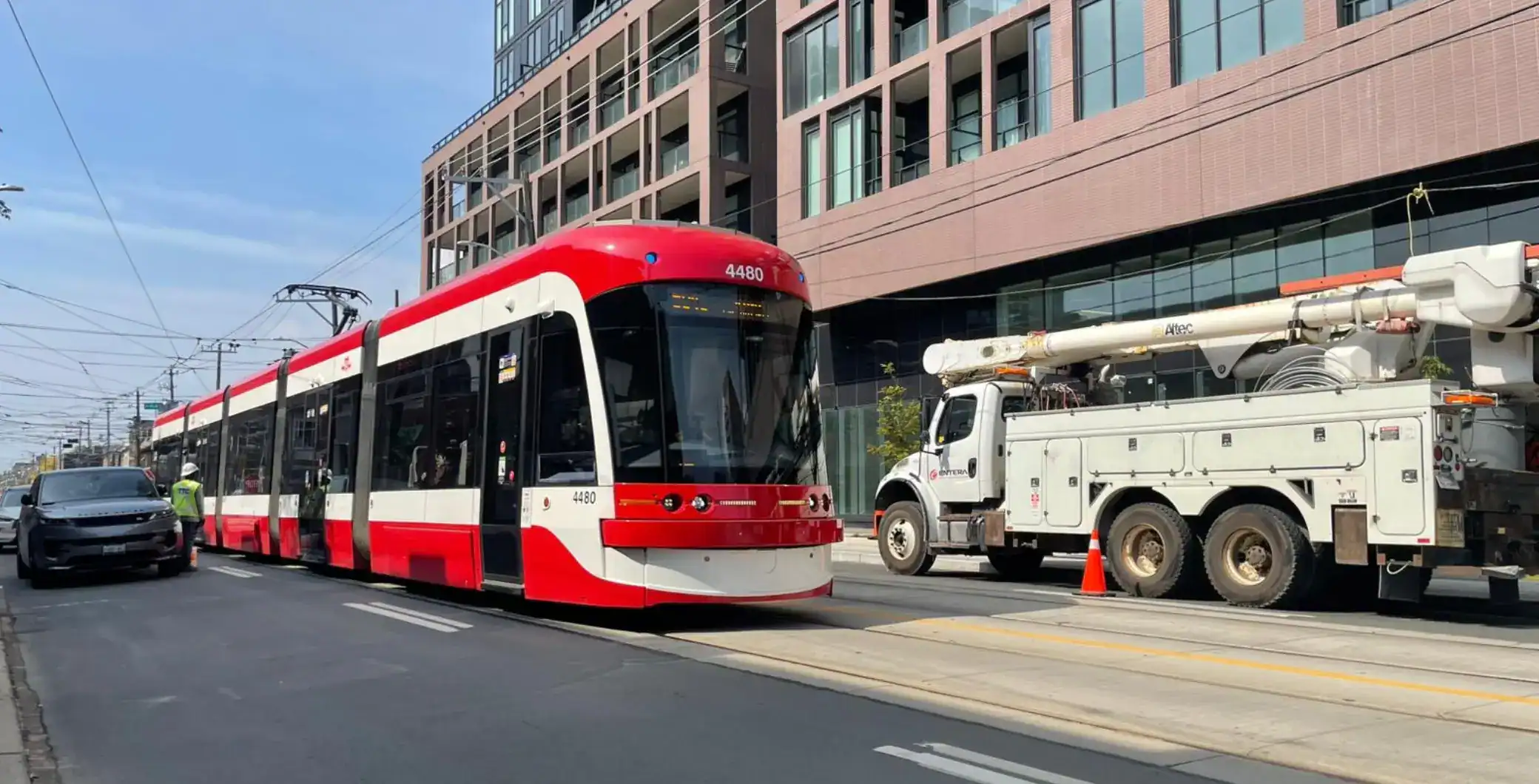
TTC riders are calling on the transit agency to do a better job of communicating about transit disruptions, as service in a busy west-end neighbourhood will be impacted starting next week.
Earlier this month, the TTC and City of Toronto announced construction plans for the intersection, including track renewals, sidewalk replacements and tactile plates installations, which will impact multiple streetcar and bus routes in the area.
While the plans were initially scheduled for “mid-September,” the TTC has recently announced that the construction will begin on Sept. 29 and continue for approximately six weeks until mid-November.
Impacted routes include the 503 Kingston Road streetcar, which has been replaced by a bus and will be running between King Street W. at Joe Shuster Way and Kingston Rd. at Victoria Park Ave. Meanwhile, the 504A King and 508 Lake Shore streetcars will be diverting between Shaw St. and Roncesvalles Ave., and the 504B will be stopping at Bathurst St.
The 29 Dufferin bus will divert to King St. W. at Joe Shuster Way through Queen St. and Shaw, while the 929 Dufferin Express will stop at Queen St. W.
The new disruptions are coming after a series of King streetcar route changes to accommodate construction at the intersection of King and Church streets over the entire summer.
Read More
Despite the advance notice of the disruptions, commuters are calling on the transit agency to improve communication ahead of service changes.
Some Torontonians feel the TTC is failing to inform riders about route changes, not providing accessible information ahead of time or even misleading commuters about service.
“What actually frustrates me is the total lack of communication around King and Dufferin. For weeks, signs have said the King streetcar wouldn’t be running in certain directions and that riders west of King should use Queen instead. But the King car is still running normally in both directions, even though the TTC site and Google Maps say otherwise,” one commuter said on Reddit.
“[I] recently started a new job that depends on streetcar journeys and it’s been a total nightmare between unannounced diversions and delayed service. It makes getting to work on time so stressful, not knowing when the streetcar may or may not show up,” another rider added.
“No signs, misinformation from employees; Absolutely terrible service,” a different person said.
SIGNS AND STAFF NEEDED FOR BETTER COMMUNICATION
Meanwhile, Andrew Pulsifer, a spokesperson for transit advocacy group TTCRiders, told Now Toronto that he often hears complaints from commuters about the lack of proper communication from the TTC, not only during major service disruptions, but “all across the system.”
He explains that while the TTC pushes announcements about upcoming route changes on its website, many people might not be constantly checking these notices, leaving them unpleasantly surprised by disruptions.
“Imagine you’re a commuter or a transit rider who takes that line every day. You don’t look at the website, you just assume that your streetcar is going to come on time every day. And then one day you arrive, [and] there’s a sign up that says, ‘No, you have to walk four blocks up north to Queen,’” he said.
Besides impacting people’s commuting plans and schedules, Pulsifer says not having enough information about disruptions can decrease people’s confidence in the transit system, which leads many to turn to cars to move around the city.
“It erodes confidence in the system. It makes people think, ‘Well, maybe I should get a car,’ which adds to congestion, or, ‘Well, maybe I should take an Uber,’ which adds to congestion,” he said.
“The streetcar in particular is not doing very well right now. Streetcars only arrive on time 57 per cent of the time, which is wild. So, streetcar transit riders in particular have, I’m sure, little confidence in the system.”
Meanwhile, a TTC spokesperson says that the agency will soon release more information about the changes caused by the King and Dufferin disruptions, including the construction’s completion dates. According to the agency, they will also be positioning pole cards, customer service representatives and digital announcements to communicate commuters about the changes.
“We have posted service changes on our website, and there is more to come as the dates are being finalized. We understand the frustration diversions cause, but this work is essential to ensuring the long-term reliability of the network,” the spokesperson said in an email to Now Toronto on Tuesday.
Nevertheless, Pulsifer says the TTC needs to do more to properly inform the public, including putting up signage, giving out flyers and assigning more staff on site to help commuters in the impacted areas.
Moreover, he also said that the TTC and the city should work on other measures that can limit disruption during construction periods, including limiting parking, including priority lanes and allocating more replacement vehicles.
“What they should do is they should put signage ahead of time. Like, they should put a sign so if you go to that stop every day for your commute to work, or your trips to the hospital, or your trips to visit your parents, you’ll be able to give yourselves some time to coordinate when there’s a disruption.”
The new TTC CEO Mandeep Lali has recently also promised to be more transparent about service issues.
Read More
In a report released this summer, Lali said that he intends on taking the TTC himself to get a firsthand experience of how the transit agency is operating.