ANOTHER AFRICA by Binyavanga Wainaina, Roland Schimmelpfennig and Deborah Asiimwe, directed by Ross Manson, Liesl Tommy and Weyni Mengesha, with Milton Barnes, Tom Barnett, Maev Beaty, Araya Mengesha, Tony Nappo, Muoi Nene, Lucky Onyekachi Ejim, Ordena Stephens-Thompson, Kristen Thomson and Dienye Waboso. Presented by Canadian Stage and Volcano Theatre at the Bluma Appel (27 Front East). Previews from Monday (September 26), opens September 29 and runs to October 22, Monday-Saturday 8 pm, matinees Wednesday 1:30 pm, Saturday 2 pm. $22-$99. 416-368-3110. See listing.
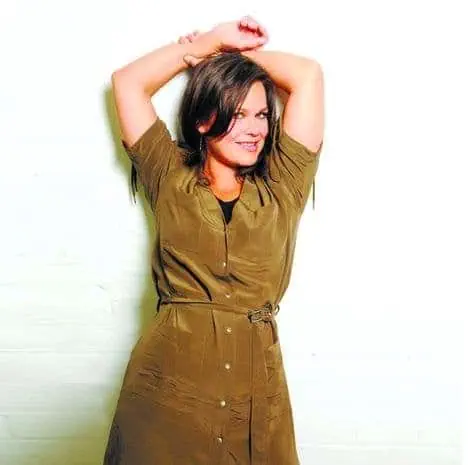
There’s a moment in Another Africa when Kristen Thomson’s character engages in a slapfest with co-star Maev Beaty. It’s a climactic scene, with the two women shouting and tearing into each other.
So, will this be done via a theatrical trick? Or will it be real, juicy palm-on-face action?
“I hope you’re not left wondering,” says Thomson, smiling, without missing a beat. “I hope by the end of the play you have your answer.”
That’s the kind of clever response I’d expect from one of Canada’s best actors. If there’s anyone who can lay bare her emotions onstage, it’s Thomson.
Consider some of her best-known roles: Problem Child’s distraught young mom who’ll do anything to get her child back from social services the sympathetic and practical nurse who helps Gordon Pinsent’s philanderer reach his Alzheimer’s-suffering wife (Julie Christie) in Away From Her and especially, in her first script and the project she’s most associated with, the preteen title character in I, Claudia, who’s coping with her parents’ separation.
These are such psychologically rich portraits, you believe them all the way. So even if her hand doesn’t connect with Beaty’s face, you’ll think it does.
In Roland Schimmelpfennig’s Peggy Pickit Sees The Face Of God, one-half of Another Africa, a remount (with a new prologue) of two scripts that debuted in 2010 at Luminato, Thomson plays Liz, a wife and mother in an unnamed Western city who, with her husband, reunites with their old friends, a couple who’ve just come back from Africa.
“There are a few plays that feel kind of like holy missions, and this is one of them,” says Thomson, nursing a tea upstairs at Balzac’s in the Distillery District, after a long day at the Canadian Stage rehearsal hall a few minutes away.
All four characters are physicians, and their dinner party soon turns into a metaphoric minefield as the four step around issues of first-world privilege, humanitarian aid and the idea of living a meaningful life.
“In North America there’s a tendency to believe that every problem has a solution,” says Thomson, choosing her words carefully. “That’s actually not true. There are some problems that, when you engage with them, become more complicated. Every time I start to talk about the play and try to say what I think it’s about, the conversation keeps turning over.”
As if on cue, Judy Collins wafts from the café speakers singing Both Sides Now, the part about not knowing life at all.
One reason Thomson wanted to take on the role (played during Luminato by Jane Spidell in a Dora-nominated performance) was to work with Ross Manson. He spearheaded the work, which has evolved over four years on three continents, and directs the program’s other half, Binyavanga Wainaina’s Shine Your Eyes.
“Ross has a particular kind of vision and ambition that takes him outside of Toronto,” she says. “He’s really hungry to meet international artists and to bring different theatrical languages to what he’s doing. There’s a lack of political theatre [here], and Ross and Volcano have a mandate to do political theatre.”
Thomson doesn’t take on just any acting role these days, mostly because she’s a busy wife (her husband, Hussein Amarshi, founded the film company Mongrel Media) and mother to their six-year-old twin boys and four-year-old girl.
She’s also developing a new script as writer-in-residence at Crow’s Theatre, tentatively called Someone Else, about a middle-aged couple.
“They’ve been together for 18 years. He’s a doctor in a clinic and she’s a stand-up comedian in a creative slump,” she explains. Thinking about getting older inspired the piece.
“None of us is completely on schedule, right? You think, ‘How did I end up here and not there?’ And ‘What do I make of this?’ I think middle age is another kind of adolescence, a time when a lot of stuff is changing.”
One thing she’s enjoying about aging is changing along with her community. She’s known her Another Africa co-stars Tony Nappo and Tom Barnett for a long time, and Beaty for a number of years.
“So when we talk in the play about how we’ve changed over the years, I have a point of reference for what that means. I love having these relationships that kind of become part of the working environment.”
Thomson almost didn’t get into theatre at all. She studied English and politics at U of T. Then her best friend died in a car accident, an event that shook her and eventually made her pursue something she really wanted to do. She switched to the drama program, graduated, then enrolled at the National Theatre School.
When I ask about other key moments in her career, she singles out three people, in no particular order: George F. Walker, who wrote Problem Child and the other Suburban Motel plays the late Urjo Kareda, who convinced her to write I, Claudia at the Tarragon and Chris Abraham, who’s helping her develop her new play at Crow’s and directed the award-winning stage and film versions of I, Claudia as well as its tour last year to the Edinburgh Festival.
She also says Soulpepper has given her constant support, especially through the years of raising children.
“Theatre’s always a collective undertaking, so it’s nice to know there are people who are willing to stick with you through the years,” she says. “Not just piece to piece, but [for a while]. To have a place in that community is amazing.”
It’s one of several times in our conversation she mentions support and community – so I have to ask how she feels about the current conservative attitude (federally, municipally) to the arts.
“I want the city, the province and the country I live in to be a place where there’s some recognition that we’re not just managing an economy but also trying to make a place that’s habitable for people to live together peacefully,” she says.
“The arts are very much a part of that. There’s this feeling that the arts are a frill, something expendable and elitist. But really, the arts are inside everyone’s home, and professional artists add to the mix of the kinds of stories that are being told and the way they’re told. Isn’t that what we do when we talk to each other? We tell stories.”
Learning about life through story-telling – it’s part of Another Africa, and it’s also part of I, Claudia, which Thomson calls not literal autobiography but emotional autobiography. Her parents divorced when she was seven.
“Somebody once said to me, ‘You should thank your parents for getting divorced! That’s why you could write this play!'” she says with her distinctive husky laugh. “I think there’s something affirming in it. Taking something that happened and turning it into a story that communicates something to whoever sees it. That’s great.”
Interview Clips
Thomson on George F. Walker’s Problem Child, his advice about being “a genius of the heart” and the social situation in Toronto at the time:

On Urjo Kareda and Chris Abraham:
On seeing I, Claudia performed by others:
On her children’s understanding of what she does:
glenns@nowtoronto.com