
What to know
- Poems in Passage is back for its 2026 season, featuring 15 poems displayed across TTC buses, streetcars, and subways.
- The program received over 1,000 submissions this year, highlighting a wide range of diverse Canadian voices.
- Featured poets include Patrick de Belen and David Silverberg, whose work explores themes of humanity, connection, and love.
- The initiative aims to transform public spaces into moments of reflection, with future plans to expand beyond transit.
For Toronto commuters, the TTC is usually a place of habit: the same platform, the same delays, the same tired scroll through phones before work or school. But tucked between ads and route maps, Poems in Passage is asking riders to look up, slow down, and feel.
Now in its third season, the grassroots public art initiative and non-profit organization has become a familiar and quietly powerful part of the city’s transit landscape, placing poetry inside buses, streetcars, and subway cars across the city.
What began as an idea between two best friends has since grown into a citywide literary project that not only spotlights Canadian poets but also reimagines public transit itself as a place for reflection and connection.
For co-founder Latif Murji, the idea was born out of memory, longing, and a sense that the city had become a little bit dimmer in the aftermath of the pandemic.
Murji and co-founder, and childhood friend, Addesse Haile, were reflecting on how COVID-19 had changed Toronto when they began thinking about the TTC not just as infrastructure, but as a public space that had lost some of its warmth and vibrancy.
“COVID made things kind of darker, and empty. We noticed that the TTC was this place that used to have more vibrance, and there used to be poetry on the TTC two decades ago when we were kids. We used to ride the bus back in Scarborough, and we would see the poetry. We were inspired all the time,” he said.
That sense of nostalgia soon turned into curiosity. When the pair realized Toronto’s old TTC poetry initiative, Poetry on the Way, had disappeared years earlier, they began by asking a simple question: why not bring it back?
What followed was a rapid and ambitious six-month buildout that took the idea from a thought to a public art installation. Murji said the team moved quickly, securing support from the TTC and Pattison, recruiting poet Britta B. as the organization’s inaugural poet-in-residence, building community partnerships with Toronto Poetry Slam, and launching a national call for submissions.
It started with hundreds of entries and has now grown into more than 1,000 submissions, evidence of the city’s deep creative talent.
Murji describes the project not simply as a poetry campaign, but as a movement rooted in accessibility, community, and care. That intention shapes everything from the selection process to the design of the posters themselves. Each season’s poems are chosen not only for literary merit, but for how they might resonate with riders moving through the city.
“We make sure that these poems speak to themes that will make Torontonians reflect and inspire them on their commute, and also that our poets represent our city. So it’s really important to us that we’re elevating the voices of underrepresented communities, and that it is reflective of the beautiful diversity of the City of Toronto.”
That commitment to representation is central to what gives Poems in Passage its emotional weight. The project is not just about dropping poems into transit spaces; it is about making sure those poems reflect the city that reads them. Across the current season, that means a mix of emerging and established voices, a range of identities and ages, and work that touches on grief, love, memory, belonging, and hope.
Murji said the public response has affirmed the need for exactly this kind of project. Beyond the excitement from poets eager to submit and readers attending in-person events, he says some of the most meaningful reactions come from everyday riders who unexpectedly encounter a poem in the middle of an ordinary day and leave changed by it.
For Patrick de Belen, poetry’s power lies in lived experience
That language, of poetry changing the trajectory of a day, comes up again and again in conversations around the project. It also surfaces in the work of one of this season’s featured poets, Patrick de Belen, whose poem AI Writes Better Poetry Than Me taps directly into the anxiety of the current moment, while defending the emotional depth of human creativity.
A Toronto-based Filipino-Canadian poet, filmmaker, educator, and storyteller, de Belen has spent years using poetry as both a personal outlet and a community tool. He said writing has long been intertwined with his mental health, but also with his desire to make sense of the world around him.
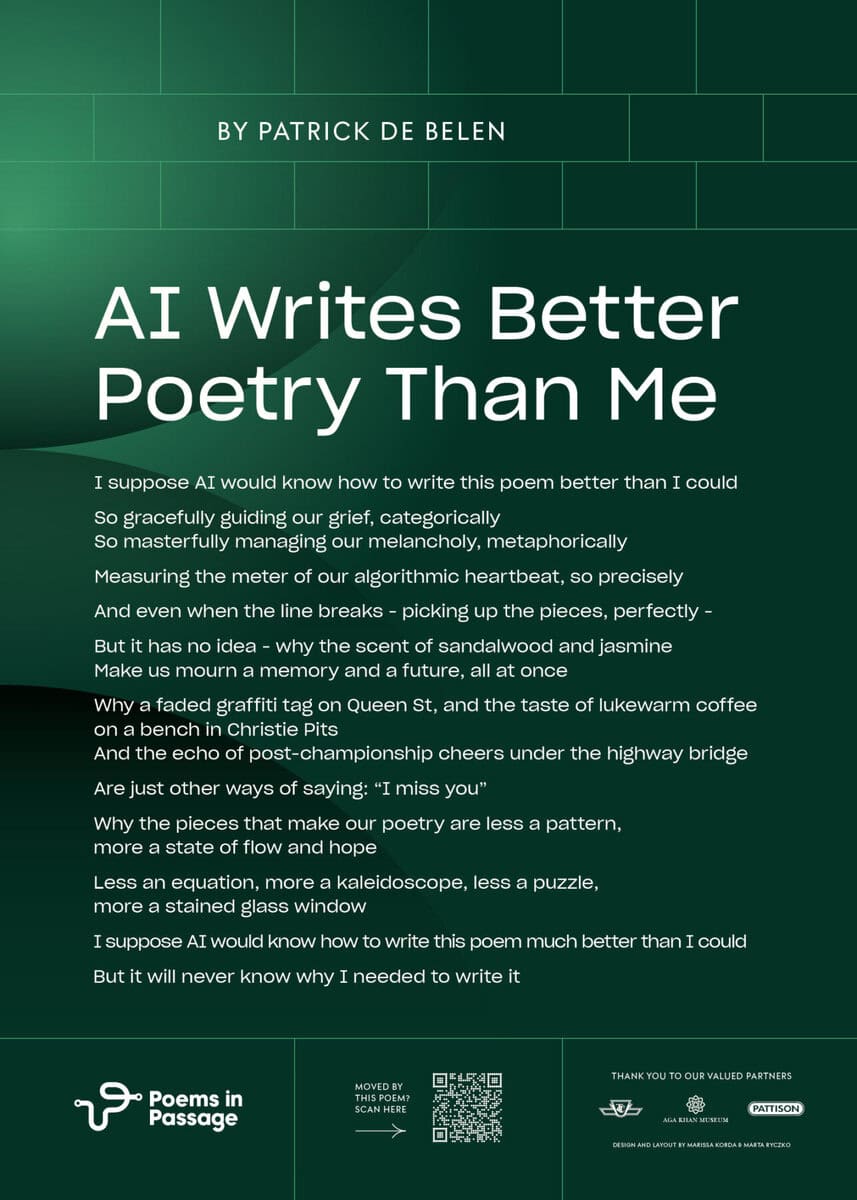
The poem itself emerged from repeated conversations he was having while creating art in public. De Belen often brings a typewriter to markets and public spaces around Toronto, where he writes personalized poems for passersby on the spot. As artificial intelligence became an increasingly cultural conversation, he found that people were asking him the same question again and again: was he afraid of AI replacing artists?
“A lot of the questions that would get asked on the street were what I felt about AI, and am I scared of AI taking over the world of creativity and storytelling. And I think a lot of artists get asked that question, and I think the poem is a response to that, really.”
But rather than taking an alarmist stance, de Belen’s answer is rooted in embodiment. For him, poetry is inseparable from lived experience, and that is exactly where human storytelling remains irreplaceable.
“It’s just talking about how I think human-to-human connection is important now more than ever, and poetry on the subway is a part of that, encouraging us to connect and be present in the moment, rather than stuck on our phones on our commute, which we are known to do often, but encouraging us to look up and disconnect. I’m not scared of AI, because the one thing AI can’t do is actually experience the things we experience as storytellers.”
De Belen grew up in Toronto and uses transit, so seeing his poem enter that space feels both deeply personal and politically meaningful. In a city where commuters are often rushed, overstimulated, or emotionally worn down, he sees public poetry as a way of helping people process both the world around them and what’s happening inside themselves.
“It’s been one of my dreams to have a poem on public transit. As someone who grew up in Toronto and took the transit all the time. It’s a huge honor to be on public transit, something I take all the time still and I think that more people need poetry now to help them digest what’s happening in the world and what’s happening in their own lives,” he said.
De Belen’s broader work as an educator also gives him a clear sense of what poetry can do when it meets people where they are. Through workshops in schools, jails, and community spaces, he has watched people find language for themselves for the first time. That repeated experience of witnessing new voices emerge has only strengthened his belief in poetry’s power.
“Just shepherding that process of them finding their voice, navigating their voice, and ultimately becoming empowered by it. To be a poet, to go through that experience every day, you’re reminded about the power and importance of your art form. And so it’s a huge privilege to watch it happen in someone who’s never written a poem for themselves before, and then they write their first one.”
David Silverberg’s TTC poem turns longing into hope
That same idea, poetry as a bridge between feeling and public recognition, appears differently in David Silverberg’s Our Love, another poem featured in this season’s cohort.
A spoken word artist, journalist, editor, writing coach, and former artistic director of Toronto Poetry Slam, Silverberg brings decades of experience in both performance and literary craft.
Silverberg said he originally wrote Our Love roughly 14 years ago, during a time when he was single and weary of the shallow rhythms of app-based dating. The poem came out of longing, not just for romance, but for a kind of intimacy that felt deeper, more playful, and more alive than the swipe culture around him.
“It’s a poem about unrequited love and the love that I wanted to see in a relationship as I was single at the time, using apps like Tinder and Hinge and just feeling like it was a shallow world of online dating and swipe culture, it made me wonder if there was just a better way. And that got me kind of pining for the kind of relationship that I want to have in my life, which translated into that poem called Our Love.”
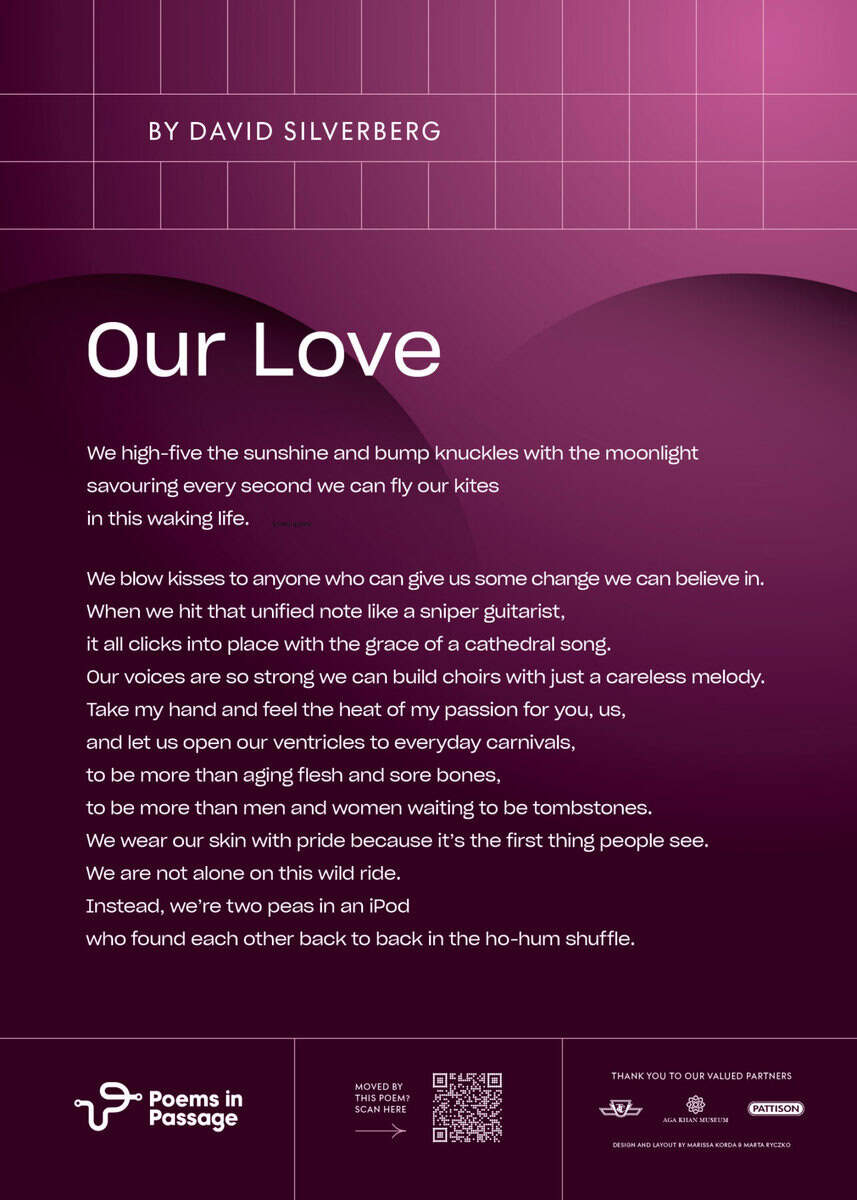
Now, years later, Silverberg says he dedicates the poem to his partner, Rachel, who has brought many of the hopes in the poem to life.
Silverberg returns to hope, intimacy, and playfulness. He wanted the piece to remind readers that love is not just grand or dramatic, but also capable of making the world around you feel more vivid.
“I think giving people hope that there is this kind of intimacy you can have with somebody that makes you feel alive and young and passionate for the world, and your kind of love for them can also spark love for things around you, whether that’s nature or seeing the beauty and small things every day, finding time for yourself. Love is also important, and being playful, is part of this poem’s message,” he said.
For Silverberg, the TTC is an especially meaningful space because it puts poetry in front of people who may never choose to seek it out themselves. Our Love is not just a personal poem but an accessible one, a piece that meets readers at different stages of longing, heartbreak, or contentment and invites them to feel a little less alone.
“What I like about this poem is that it feels very accessible and in the way that I think, whether you’ve been in love or haven’t been in love, or even thought wistfully, is my life like that rom com I just saw last night. I think it touches upon all of us at a certain age.”
And if someone happens to read it during a lonely or difficult commute, he hopes the poem offers not fantasy, but possibility.
“That you’re not alone if you’re thinking the same thing that I was thinking all those years ago, which is ‘why not me.’ It doesn’t happen overnight. It doesn’t happen by accident. So hopefully my poem might open a few hearts and minds to realize that they can have the capacity to give and to have the love that they want in life,” Silverberg said.
What’s next for Poems in Passage
While the initiative has become a beloved feature of the TTC, Murji says the organization is already thinking beyond transit and toward a broader vision of public art as something that can actively improve the lives of Canadians nationwide.
“We’re looking ahead to opportunities to put art in other public spaces. We’re thinking about what other spaces can be enriched with art, because that’s our mandate. We want to bring art to public spaces. So that’s beyond just public transit. We’re also looking at other cities for public transit, but we’re thinking in Toronto of other public spaces. We’re thinking about events. We’re thinking about other ways that we can bring community together and involve everyone in the production of art,” he said.
What excites him most is not only expansion, but the philosophy underneath it: the belief that public art is necessary.
“The idea of collective art making and public art, and thinking about public art as a public health intervention, something that will improve the mental health of the population as a whole. Those are the ways that we’re starting to think about it.”
In a city where commuters often tune out, Poems in Passage is making a quiet case for tuning back in: to language, to one another, and to the emotional connections that move through Toronto every day.


