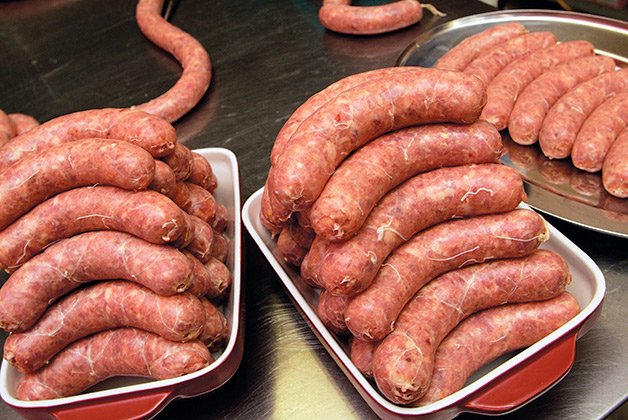
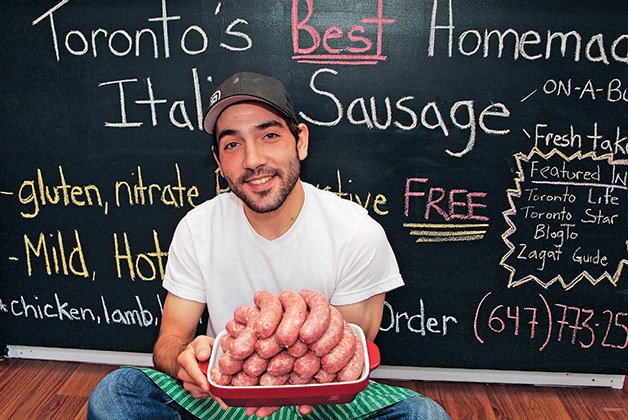
Mario Carmine Garisto wants you to know why the sausage he sells at his new shop, Sorella Toronto (2763 Dundas West, 647-773-2582, sorellatoronto.com, @sorellatoronto) is so tasty. It’s because he uses a century-old recipe passed down by his great-grandmother from the southern Italian region of Calabria. The recipe could be older he doesn’t know. His pork sausages are so good, a customer told him that her vegetarian daughter couldn’t resist them.
Though the precise recipe remains a family secret, Garisto is happy to show us what goes into the creation of a quality sausage.
Butchering
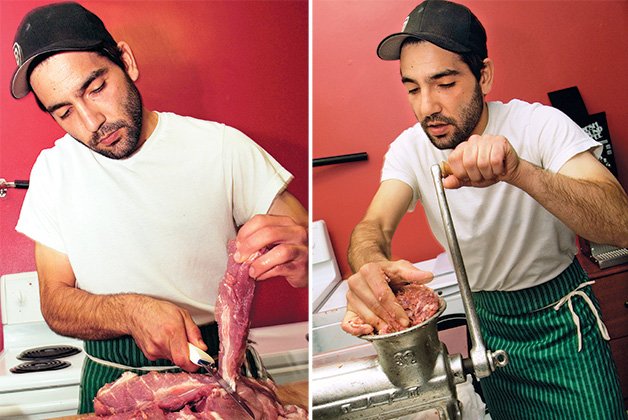
While sausages are usually known as a dumping ground for trimmings and scraps, Garisto only uses pork butt.
“Pork butt is marbled very well, with no gristle,” he says. “The fat, the white parts, is pliable and can be rendered easily. In cheap sausages, the fat is hard and has to be ground more finely.”
He spends two hours butchering a box of six pork butts, removing the veins, tendons, bones, silver skin and excess fat until the butt has an approximate ratio of 85 per cent meat to 15 per cent fat.
He gets the pork from Bloorcourt’s Nosso Talho (1042 Bloor West, 416-531-7462, nossotalho.com). “I used to work there, and the Portuguese know their meat.”
Grinding
The meat is then fed through an electric grinder, though Garisto puts the gauge to a higher setting so the ground meat comes out coarser rather than as a fine paste.
“You almost want to be eating chunks of meat, and it should fall apart when you eat it,” he says.
The reason? Seeing and tasting little chunks of pork takes the mystery out of mystery meat.
Seasoning
The ground pork is then weighed and divided into three batches, for mild, hot and Garisto hot. Salt and chili flakes are the only other ingredients added to the mix. More than two decades ago, Garisto’s mom and aunt spent many nights trying to translate their grandma’s pinches and handfuls of spice into actual measurements. That old recipe card they wrote is still kicking around.
Here’s Garisto’s tip on determining how much actual meat is in your sausage: see how much it shrinks when it cooks. Fillers like oil, water and bread crumbs cook off or shrink, leaving just the meat. If the sausage shrinks to half its size, that’s how much meat was there to begin with.
“We always get compared to supermarket [products] or street meat, because people always buy sausages based on price,” he says. “I consider that an insult. I’m trying to show how Italians do it.”
Refrigerating
Garisto mixes the batches by hand and then refrigerates them for 20 minutes to help the meat bind. But first he cooks up a bit from every batch to make sure it’s seasoned properly.
Stuffing
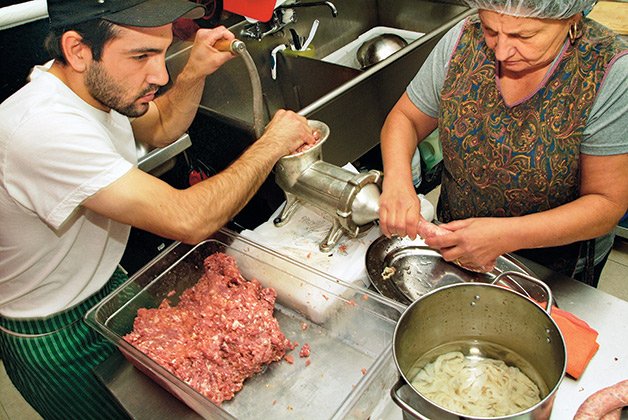
Sausage casings, the stretchy layer of a pig’s intestine, are washed three to four times to remove the salt solution they’re stored in before the hand-cranked sausage extruder is brought out. It’s been in the family longer than the 30-year-old Garisto. The casing is slipped over the extruder tube and filled with seasoned pork. When the sausage is 5 inches long, the casing is twisted. Each batch yields about 170 sausages, which sell out fast, so he recommends calling ahead to reserve them. (They’re $10 for four.)
Testing
Once the sausages are filled, some are cooked up again for a second test. “Hey, you get hungry,” he says. Taste-testers from neighbouring businesses love him for this. Most of the sausages are reserved for wholesale, though a few are set aside to be cooked up and served on a bun for a small lunch crowd ($6 with a drink).
Cleaning
At the end of the day, the whole shop is disinfected. Machines are taken apart to be washed, cutting boards are scraped off, the stove is sprayed down, scales are wiped and the fridge is cleaned inside and out. Everything also has to be disinfected when Garisto is making sausages with a different kind of meat to prevent cross-contamination.
“Cleanliness around food is extremely important, and you have to do it 100 per cent every time,” he says. “You might not be able to tell if I give it 98 per cent, but I’ll know, and that’s when your business will be in trouble.”
From start to finish, the entire process takes four hours.
Don’t miss: Five more stellar sausage spots