Cycling advocates rejoiced last year when the city announced it was stepping in to rescue the troubled Bixi bike share service.
In April the Toronto Parking Authority took over the struggling company, which was at risk of defaulting on a $4.5-million bank loan, and outsourced its management to the experienced Portland-based Alta Bicycle Share. Bixi became Bike Share Toronto, and an important part of the city’s transportation network was saved.
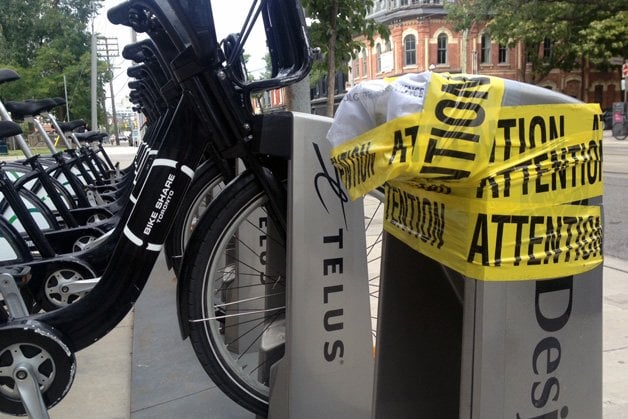
But the transition from Bixi to Bike Share has not been smooth. Some members are reporting that the system has deteriorated significantly over the past few months. They say it’s increasingly hard to find a bike or a place to dock one, docking stations are broken and aren’t being repaired, and some of the bikes have even become unsafe, turning what is supposed to be a convenient service into an ordeal.
James Redekop, a software developer, has been a bike share member for three years. He takes the GO train from Highland Creek to Union Station, and then rides Bike Share up to his office near King and Jarvis.
He says that under Bixi he could usually find a place to park his bike at the station nearest his office, and only about once a month would he arrive to find that all the docks were already taken. “Since the handover it seems like it’s closer to weekly,” he says. “When it has happened, it’s been harder to find a fallback station because my usual fallback station [at Princess and Adelaide] has been completely inactive.”
Now, to find a free dock he sometimes has to backtrack below St. Lawrence Market, and if he can’t find an open dock there, he ends up back where he started at Union Station.
Steve Fisher, an arts writer and listings editor for Torontoist, has also been a member since 2011. On Tuesday he rode to the station closest to his home, at Wellesley and Sherbourne, and although the station display said one spot was open, the only free dock was broken and wouldn’t accept his bike.
Two weeks ago when he couldn’t find a dock, he tried calling Bike Share’s help line to be directed to an available station. The woman who answered was at a call centre in Idaho. “She sent me to two non-existent locations. In her system they still showed as operative, and they’d been gone [for a while],” he says. It took him an hour to get rid of the bike. “I was a little frustrated.”
A bank worker named Renval, who asked that his last name not be used, had terrifying experience on his way to work last week. The Spot Cycle app told him there were four bikes available at the station near his house at Niagara and Richmond, but when he got there none of them were in service. So he walked over to Ossington and Queen where he found a working bike. Already late, he sped east on Queen-only to discover the bike’s brakes didn’t work. He had to stop himself with his feet.
“That was probably one of the scariest moments of my life,” he says. “You start pedaling as fast as you can, you get to a red light and you can’t stop… Nobody should have to deal with that.”
When he bought his first membership a year ago Renval was such a strong advocate for the program that he says he enquired about doing a charity ride along Lake Ontario on a Bixi bike. Now he’s considering letting his membership lapse when it comes due next month. “It just doesn’t seem worth it anymore,” he says.
Scott Hancock, Alta’s general manager for Bike Share Toronto, says he’s “a hundred per cent aware” that the system’s problems are mounting. He attributes the deterioration to the recent bankruptcy of Bixi’s parent company, the Montreal-based Public Bike System Company (PBSC), which was the main source of replacement parts for bike share systems across North America.
PBSC filed for bankruptcy in January and “the supply of parts to maintain the system disappeared”, Hancock says. “The entire supply chain was disrupted.”
Toronto’s system isn’t the only one that’s been affected. This spring, Washington, DC’s Capital Bikeshare put a planned expansion on hold because it was unable to buy new infrastructure from PBSC.
Alta has tried to find other sources for the parts but some of the system’s components are propriety and belong to PBSC. In April a Quebec businessman bought PBSC’s international operations, and Hancock is hopeful that “eventually they’ll be able to re-establish their supply of parts.”
In the meantime, Bike Share Toronto is operating at reduced capacity. Seventy-five of the system’s 1,500 docks and two entire stations are currently out of service and can’t be fixed until new parts arrive. “That’s five per cent of our capacity gone, and that hurts,” says Hancock.
In addition to the problems with the docks, many of the bikes are overdue for maintenance. Typically, the vehicles are supposed to undergo a major rebuild once every two years, in order to replace vital parts like their chains, drivetrains, and hubs. When Alta took over in April, Hancock says that only about 20 per cent of the 1000-bike fleet had been overhauled over the winter, and instead of taking the bikes out of service as the busy riding season approached, Alta opted to do basic repairs but defer the rebuilds until the fall.
Hancock is optimistic that Alta can fix Bike Share, but predicts it could take months to restore the system to full health.
“I’m hoping that for next year the system is completely established. We’re going to put a lot of remediation into it this fall,” he vows.
Councillor Denzil Minnan-Wong, the Public Works chair who engineered the TPA’s takeover of Bixi, did not return a request for comment. But Marie Casista, the TPA’s VP of Real Estate, Development, and Marketing, has no doubt that Alta will ride out what she describes as “growing pains.”
“It is the largest bike share management company in North America. They run major systems,” she says. “And we are quite confident in their ability to manage and to operate the system in the first class manner that we desire.”
So far, it doesn’t appear that Bike Share’s struggles have affected its membership. Numbers provided by Alta show that the program now has 3,919 members, up from 3,544 at this time last year. It’s logged 276,388 rides since April 1.
But the program has historically struggled to make money last year Bixi was between $100,000 and $200,000 short of breaking even. A search for a major corporate sponsor has yet to yield results (although Casista says the TPA has held positive talks with a number of interested parties).
Bike Share’s supporters have long argued it needs to expand beyond the 80 stations it has in the downtown core, and sign up as many as 6,000 members if it’s going to become financially viable.
Although plans to add 22 stations in 2014 were announced in December, the timeline for their arrival has now been pushed back to spring of 2015. It could be difficult to grow the system until the existing operations are stabilized.
bens@nowtoronto.com | @BenSpurr