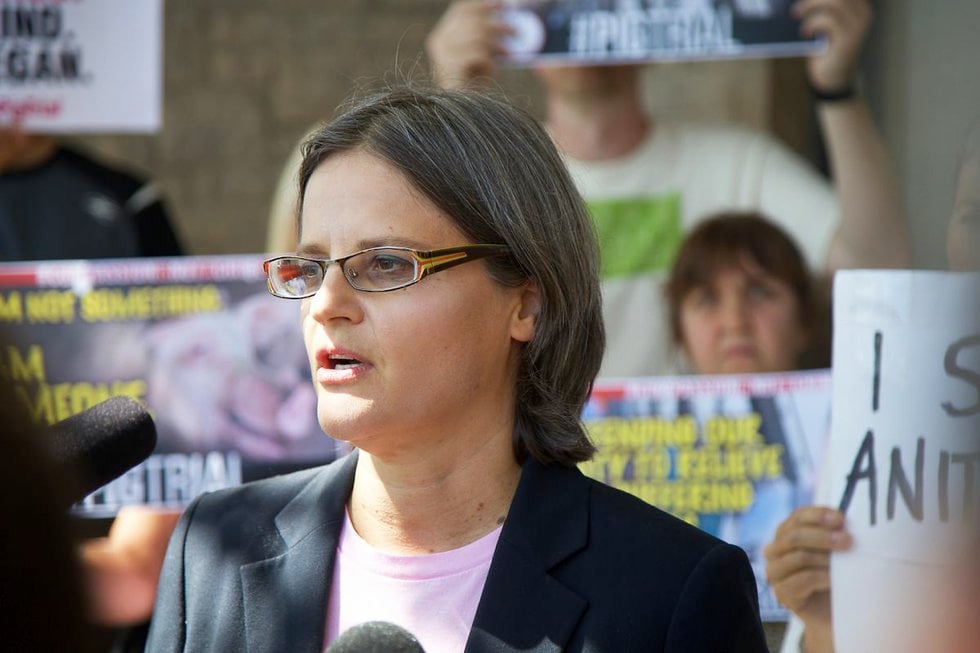
A Burlington courtroom became the unlikely backdrop of the international struggle for animal rights when Anita Krajnc of Toronto Pig Save appeared on August 24 to face a charge of criminal mischief for giving water to a pig in a truck on its way to a local slaughterhouse last summer.
The courtroom was filled to capacity for the two days scheduled so far for the hearing with animal rights activists wearing Pig Save T-shirts and stickers reading “I am Anita.” The case has caught the attention of press in the U.S. and the UK, thrusting the conflict between industrial farming methods and the growing veganism movement into the spotlight.
The proceedings have proved a lesson in the politics of meat.
1. “These are not humans, you dumb frickin’ broad”
“My concern is I don’t know what’s in the water,” said Jeffrey Veldjesgraaf from the witness stand.
Veldjesgraaf drove the truck transporting pigs from Van Boekel Hog Farms in Otterville that was met by Krajnc and other activists at a traffic light outside Fearmans Pork Inc. last June. He called 911 as Krajnc gave the pigs water, and Pig Save activists captured his exchange with her on video. At one point he’s heard telling Krajnc, “These are not humans, you dumb frickin’ broad.”
Veldjesgraaf testified that the activists from Pig Save holding weekly vigils outside Fearmans were becoming a nuisance.
“We all came to the conclusion that somebody has to do something about it,” he said. It’s not clear who the “we” is from Veldjesgraaf’s testimony, but the theory has been posited by Krajnc’s lawyers that the charge against her is politically motivated, encouraged by “big meat” economic interests.
In an earlier witness statement to Halton police, Veldjesgraaf said, “This needs to be stopped, as they are messing with our livelihood.”
Eric Van Boekel, owner of Van Boekel Hog Farms, testified that his initial concern over Krajnc’s giving pigs water was that “there was a contaminant that entered my truck, which my property was on.” He conceded under questioning from Krajnc’s co-counsel James Silver, however, that the pigs in question went to slaughter and there was no monetary loss as a result of Krajnc’s protest.
All of which, co-counsel Gary Grill suggests, fails to “prove the necessary elements” for the mischief charge against Krajnc – namely, “interference with the use, enjoyment and operation of property.”
Krajnc’s lawyers also raised Van Boekel’s prior convictions for discharging raw manure into Sweets Creek and the Thames River after repeated warnings from the Ontario Environment Ministry.
“History proved that we were wrong,” said Van Boekel during questioning, adding, “It is a very serious matter, and we have addressed it, as someday I hope your client will realize her mistakes.”
2. Bringing home the bacon: pork is big business in Ontario
Van Boekel’s 1,000-plus-hectare operation supplies about 110,000 pigs annually exclusively to Fearmans. The court heard that his gross yearly sales amount to $20 million. The industry as a whole, however, has faced increasing market pressures as well as scrutiny from environmentalists.
In 2014, the Ontario government granted the pork producers marketing board $2.4 million to establish the Ontario Pork brand. That same year, the province forked over another $2 million to help the industry manage the spread of the porcine epidemic diarrhea virus.
“We are facing societal pressures, changes to environmental policies and herd health issues,” wrote Ontario Pork chair Amy Cronin in the organization’s 2015 corporate profile.
Among those societal pressures is the fact that people are starting to wake up to the benefits of eating less meat.
A 2015 report by the Food Institute of the University of Guelph found that 5 to 9 per cent of Canadians are vegetarians and that 38 per cent had either reduced or stopped their consumption of beef in the preceding 12 months. The reasons included health and food safety, ethical and environmental concerns.
Krajnc founded Toronto Pig Save in 2010, and what’s since been dubbed the Save Movement has since grown to 60 groups worldwide who bear witness to the fates of animals before they arrive for slaughter.
3. Meat is murder
The pigs inside Van Boekel’s truck on June 22, 2015, were in severe distress, according to veterinarian Armaiti May, who testified as an expert witness on Krajnc’s behalf.
May analyzed the Pig Save activists’ video and determined that two pigs were panting as quickly as 180 breaths per minute. She did this by counting the number of exhales from the nostrils of the pigs in one brief clip.
The defence and Crown attorney agreed that the temperature that day was 26° Celsius, with a humidity index of 61 per cent, but disagreed on whether this caused the pigs to be in distress or not.
Regulations allow for pigs to go without food, water or rest in transit for up to 36 hours.
According to Anna Pippus, director of farmed animal advocacy at Animal Justice, more than 8 million animals every year arrive at slaughterhouses dead or so sick or injured that they are declared unfit for human consumption.
4. Patriarchy is alive and well in animal husbandry
One of Van Boekel’s supporters showed up in court wearing a T-shirt from a barbecue restaurant with the image of a pig and the words “I like pig butts and I cannot lie.”
The words are a play on the song Baby Got Back: “I like big butts and I can not lie / You other brothers can’t deny / That when a girl walks in with an itty bitty waist / And a round thing in your face / You get sprung….”
Carol Adams, the author of The Sexual Politics Of Meat, says gender oppression and species oppression go hand in hand. Calling someone a “bitch,” “fat cow,” “old sow” or even “hot chick” are ways of projecting hatred and degrading other bodies.
Animal agriculture is dependent on the reproductive exploitation of female animals.
In his testimony, Van Boekel explained why mother pigs are kept in crates that are so tight that they can’t even turn around. “A sow has her little pigs and as most mothers can attest to [when] having babies, their hormone levels flare up and they kind of don’t know what they are doing.”
5. Animals are people, too
Ontario’s Prevention Of Cruelty To Animals Act says that “no person shall cause an animal to be in distress.” But that doesn’t apply to “an activity carried on in accordance with reasonable and generally accepted practices of agricultural animal care, management, or husbandry.”
In 2012, the Supreme Court of Canada rejected an application to hear an appeal from animal rights activists against the city of Edmonton over the future of a 36-year-old Asian elephant named Lucy. Zoocheck and People for the Ethical Treatment of Animals alleged that the shelter in which the lone elephant had been confined failed to meet the city’s obligations under Alberta’s Animal Protection Act.
The year before, the Alberta Court of Appeal had ruled against Lucy’s supporters, but that court’s chief justice, Catherine Fraser, wrote a dissenting 42-page decision pondering the larger question of how the relationship between humans and animals under the law has been influenced by humankind’s “deepened understanding of our place in the universe.”
Fraser wrote, “Humans may be at the top of the evolutionary chain. But with rights come responsibilities, and one of them is that we are stewards of the environment. That stewardship is reflected in the legal obligations we have assumed not only to the physical biosphere, but also to the animals with whom we share the earth. Should moral, ethical or spiritual considerations not serve as adequate motivation in shaping those legal obligations, then the fact that this also happens to be in humanity’s own collective enlightened self-interest ought to suffice.”
The trial continues October 3.
Don’t miss: Toronto Pig Save inspires global animal rights activism.
news@nowtoronto.com | @nowtoronto