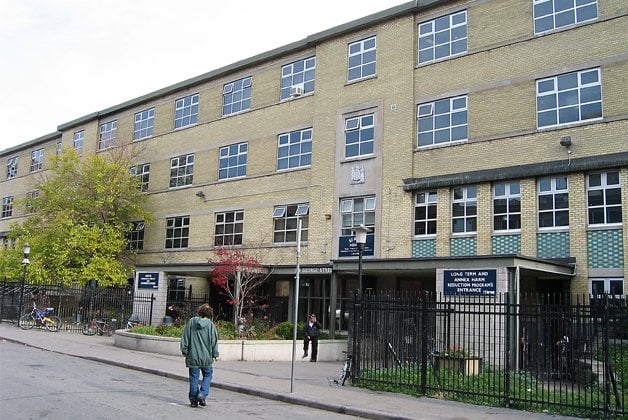
The Seaton House shelter has cast its shadow over the north end of George Street for 54 years. In that time, the brazen drug activity outside its doors has earned the east downtown street a rep that puts it in the running for worst stretch of asphalt in Toronto.
While the environment outside is menacing, inside is not much better. Built in 1959 to house welfare offices, the building was never meant to accommodate the hundreds of men who now sleep there every night. Most of the rooms lack air conditioning, quarters are close, and violence not uncommon. Many in the neighbourhood call it “Satan House.”
But big changes could soon be coming to the facility and its surround. Last week, council voted unanimously to start acquiring nearby property for a revitalization initiative that would see the shelter torn down and replaced by a new one combining a hostel, a long-term care home, community space, and possibly affordable housing or even market-rent units.
The new configuration would incorporate the row of derelict heritage buildings south of the shelter to create an institution roughly twice the size of the present one. Plans are still in the preliminary stages, but it’s scheduled to break ground in 2017.
“We know we should be doing better for these residents,” says Patricia Anderson, spokesperson for the Shelter, Support and Housing Administration. “Seaton House is too large, too old and has too many residents.”
Seaton is the city’s largest homeless facility. Of its 543 beds, 240 are used as emergency shelter, and the rest are part of long-term care, harm reduction and infirmary programs. The goal of the re-do is to lower the number of people in the emergency hostel and shift them into permanent accommodations in new affordable housing or long-term care units.
To this end, the number of emergency beds would be reduced from 240 to roughly 96. According to the report approved by council, the 140 men left over would be “absorbed into transitional housing programs or the emergency shelter system.”
The local councillor, Kristyn Wong-Tam, pledges that the project will be carried out according to a “zero displacement policy” and that no one living in the shelter will be forced to leave. “The reduction of shelter beds is really offset because there are going to be new housing options with assisted living,” she says, “so you’re not really displacing anybody.”
But not everyone is convinced. The proposed elimination of shelter beds has alarmed some homelessness advocates, especially because the plan comes after reports of a chronic shortage of shelter space this winter. In April, council voted to add more beds to the overcrowded system.
“I do see it as contradictory,” says Beth Wilson, a senior researcher with Social Planning Toronto. She agrees the city needs more permanent facilities as the homeless population ages, but believes that they shouldn’t come at the expense of ensuring shelters can cope with demand.
“[We need to] make sure that if people need a bed tonight, they’re going to get a bed tonight.”
The Ontario Coalition Against Poverty fears gentrification-by-stealth. Spokesperson Liisa Schofield warns the revitalization, especially if it includes market housing, could lead to people being “priced out of the neighbourhood.”
“When people say, ‘Let’s create a safer neighbourhood by breaking apart this concentration of poor people,’ that’s starting to sound a lot like displacement,” she says.
But despite OCAP’s concerns, most of Seaton’s current neighbours could hardly be described as vectors of gentrification. And for many of them, the redevelopment of the shelter can’t come fast enough.
In few spots in the city are hard drugs sold so openly. Visit on a typical afternoon and you’ll find three or four dealers staking out the sidewalk outside the shelter, while people in various states of inebriation or distress bolt up and down the street or lie stricken on the ground.
Brandy Cully, who lives on the first floor of a George Street co-op, says drug activity is a constant source of fear. She plans to move out as soon as she pays off her student loan. “I feel threatened every day,” she says. “I don’t leave my house at night.”
Since moving in three years ago she’s seen muggings and men beating up prostitutes outside her house. She’s afraid to let her boy outside.
Shelter residents are divided on what the revitalization could mean. “I think it’s cruel. Where is everybody going to go?” asks Frank Coburn. Coburn says his own drug use got him temporarily kicked out of the facility. He thinks that if the city changes anything about Seaton House, it should be to create a harm reduction program for drug addicts. “Pay more attention to the people who are in real need,” he advises.
Others are happy with the status quo. Donald David Luby has been at Seaton for seven years. He’s close to 70 and sometimes hears voices about codes hidden in the Bible. He would likely be a prime candidate for a spot in the redevelopment’s long-term care facility. But for the moment, he’s content to stay where he is. The staff is friendly and he’s happy to get three meals every day.
“After a while it gets kind of homey,” he says.
bens@nowtoronto.com | @bens