June 20 marks World Refugee Day, and a coalition of refugee-serving organizations and activists in Canada is calling on the federal government to strengthen protections for 2SLGBTQIA+ refugees and asylum seekers amid growing concerns about anti-refugee rhetoric and policy changes.
The world is in the midst of a displacement crisis. The United Nations High Commissioner for Refugees (UNHCR) reports there were 41.6 million refugees worldwide at the end of 2025. As Pride Month celebrations continue across Canada, advocates say recent changes to refugee policy and healthcare coverage could create additional barriers for Queer and Trans people seeking safety.
Launched on June 19, the Defend Refugees campaign aims to draw attention to the challenges facing 2SLGBTQIA+ refugees and asylum seekers while calling on the federal government to strengthen protections for this community.
Defend Refugees: A campaign advocating for Queer & Trans newcomers
Convened by The 519 and Rainbow Railroad, the campaign kickoff comes during Pride Month, and just ahead of both World Refugee Day and Toronto’s Pride Festival weekend. Rainbow Railroad’s Chief Communications and Advocacy Officer, Latoya Nugent, says that this moment offers an opportunity to bring refugee issues into broader conversations about 2SLGBTQIA+ rights and inclusion.
“Within the Queer and Trans community, we don’t always elevate the issues of newcomers or refugees,” Nugent told Queer & Now.
She says that the new campaign is particularly urgent, as the federal government has recently introduced new measures that impact refugee claimants, including provisions within Bill C-12 and changes to refugee healthcare coverage.
“Public visibility on this issue matters,” Nugent explained. “It matters a lot for Queer and Trans refugees right now, primarily because of the anti-immigrant, anti-refugee rhetoric that’s emerging in Canada.”
Read More
Advocates say the challenges facing 2SLGBTQIA+ refugees extend beyond navigating the immigration system, finding housing, settling into a new community and even combating discrimination as newcomers. For instance, many arrive after experiencing persecution because of their sexual orientation or gender identity and are required to recount traumatic experiences as part of their refugee claims.
“Some of the unique challenges [include] proving who they are, proving their sexual orientation and their gender identity,” Karlene Williams-Clarke, Director of Community Organizing at The 519, told Queer & Now. “And retraumatizing themselves talking about the issues that they face and why they’re fleeing their home countries.”
Concerns regarding Bill C-12
As anti-2SLGBTQIA+ movements gain momentum globally and refugee policies become more restrictive, advocates warn that safe pathways for people fleeing persecution are becoming increasingly difficult to access. One of the Defund Refugee campaign’s major concerns is a provision in Bill C-12 that places a one-year limit on asylum eligibility for those who first entered Canada after June 24, 2020. This applies regardless of whether that person has since left and reentered the country and applies to all claims made on or after June 3, 2025.
Williams-Clarke, who came to Canada as a refugee in 2009, explained that a lot of people experience great uncertainty during the refugee claimant process. This is something that can be heightened by this new legislation, which she says causes many to worry that their claims will be thrown out due to timing.
“I know the trauma that people face, the fear, the uncertainty and things people don’t understand,” she explained.
“They’re fearful, they don’t know what to expect, and they’re expecting to be safe, and only to [find out] that they may be returned to their country, where they were even further persecuted.”
Nugent, who also has lived experience as a refugee, argues that the policy fails to reflect the realities of many 2SLGBTQIA+ people’s experiences.
Read More
“People come to their Queerness, come to their Transness over time,” she said, explaining that this can often occur after the one-year mark.
She gave the example of people who migrate to Canada for temporary work, or to study, and because of culture in Canada, begin to realize that they are Queer or Trans.
“And after school, or that work, they may go back home, and something acute may happen that causes them to flee,” she explained. “Or perhaps they stayed [in Canada], and because of changes in legislation in their countries, it’s not safe for them to go back.”
But if it has already surpassed 12 months since their original arrival, the one-year limitation would prevent them from claiming refugee status.
“So when you have this automatic ineligibility, just based on when somebody first arrived in the country, I think it ignores the actual realities that Queer people live through,” Nugent explained, adding that advocates also worry about the data sharing provision within Bill C-12.
“Because we don’t have full clarity on whether personal information may get into the hands of the very governments that lots of people are fleeing,” she explained, highlighting that this is particularly concerning for Queer and Trans refugees.
Advocates are also concerned about access to housing, healthcare and other supports, particularly for newcomers who may be waiting months for work permits while trying to establish themselves in Canada.
In response to these concerns, the Defend Refugees campaign is calling on the federal government to revisit aspects of Bill C-12 to ensure protections for 2SLGBTQIA+ refugees, reverse recent changes affecting refugee healthcare, and increase support for housing and access to housing.
Read More
For Nugent, the conversation reflects a broader trend affecting 2SLGBTQIA+ communities in Canada and around the world. She says policy changes in Canada over the past year have raised concerns for refugees and the organizations that support them.
“Canada, for a lot of people, long represented this place of hope, where you can relocate, find refuge, a home, belonging, safety, all of those things,” the activist explained.
“With legislation like Bill C-12, you’re left wondering if things are going to begin to deteriorate in the same ways that they have deteriorated in places like the U.S.,” she added. “Specifically for Queer and Trans refugees.”
The importance of solidarity and community action
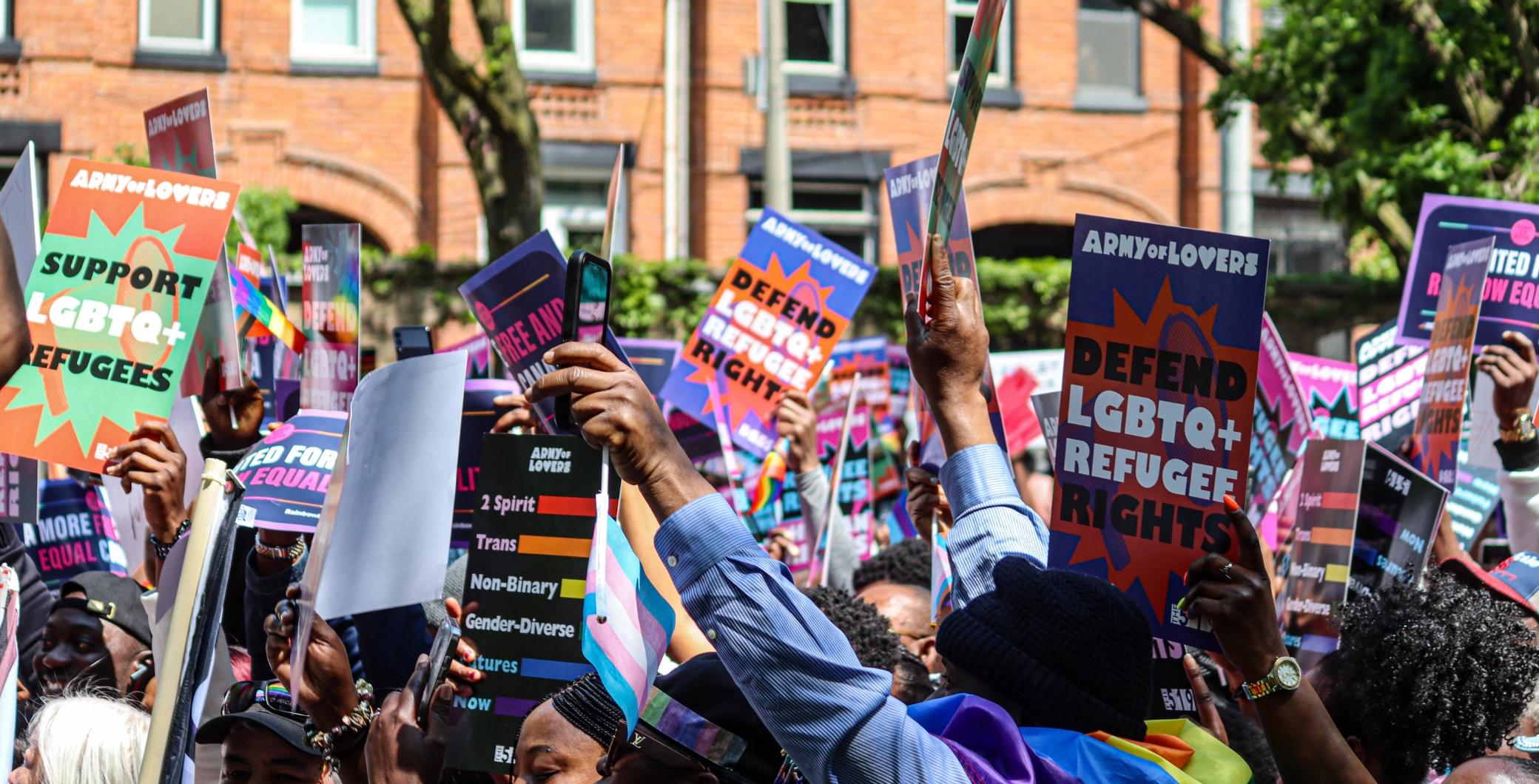
The Defend Refugees campaign launched with an activation at The 519, drawing dozens of community members, activists, and allies who gathered in the centre’s ballroom to create T-shirts, tote bags, patches, signs and buttons bearing the campaign name, The 519’s slogan: “Never Stop Serving,” and other Pride-themed designs.
“The T-shirts, the bandanas, the pins, those will play an important role in actually giving us the visibility that we think this campaign deserves,” Nugent explained.
A community gathering like this is timely, as during these times of intense backlash against Queer and Trans communities, both Williams-Clarke and Nugent emphasized the importance of solidarity and community action.
“That solidarity means something,” Nugent said. “I’ve mentioned… how much community means for Queer people who are forced to flee home, and this is community… If you needed pictorial representation of community, you’ll find it at the activation space today.”
Williams-Clarke explained that Canadians looking to get involved can do so by signing an open letter to Prime Minister Mark Carney and speaking out in support of 2SLGBTQIA+ refugees.
“There are so many negative rhetorics that are going on in society today,” Williams-Clarke said. “With legislative changes that are being made against refugees, we find it’s very important to put our voice out there and to ensure that refugees know that they’re not standing alone.”
“Refugees are human beings, Trans and Queer refugees are human beings, and they deserve the right to be in Canada like all of us.”