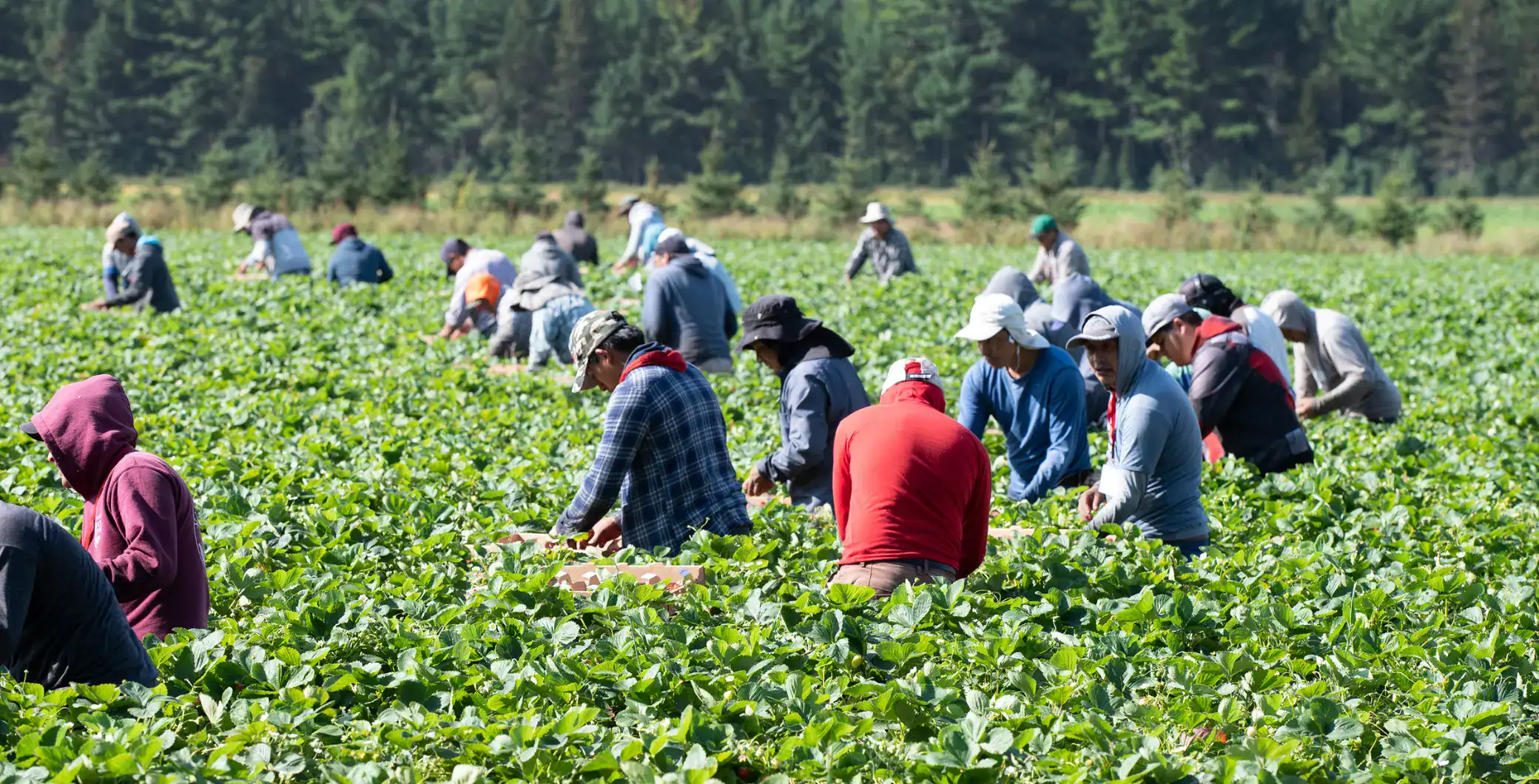
The federal government is being sued over claims that its migrant worker program is founded on racist principles.
The proposed class-action lawsuit has been filed against the federal government on behalf of migrant workers who were employed in Canada over the past 15 years.
According to The Toronto Star, the case deals specifically with farm workers and alleges that the reasoning used to justify their employment is fundamentally racist.
The conditions of migrant farm worker employment through Canada’s Seasonal Agricultural Worker Program (SAWP) tie migrants to a specific employer, unlike an open permit which authorizes people to seek work elsewhere.
SAWP was established in the mid-1960’s by Lester B. Pearson’s government and has since permitted employers to hire temporary foreign workers (TFWs) from participating Caribbean countries and Mexico when domestic agricultural labourers are unavailable.
SAWP employers are allowed to hire TFWs for a maximum of eight months per year provided they are able to offer the workers a minimum of 240 hours of work within a period of six weeks or less.
By law employers are required to pay TFWs the same wages and offer the same benefits that Canadian and permanent resident employees receive for doing the same job.
They are also obligated to prove they can provide adequate living and working conditions, to pay workers for all work, including overtime, where required by law, and provide workplace safety insurance.
But, according to reports by the Toronto Star, the lawsuit utilizes “historical records to argue that employer-specific work permits were imposed on Black and Indo-Caribbean farmworkers because of their race and that it was motivated by overtly racist policy objectives.”
Consequently, Goldblatt Partners, in conjunction with Koskie Minsky and Martinez Law, are seeking $500 million in restitution for employment insurance paid out by migrant workers despite them being ineligible for benefits if they lose their job, The Toronto Star reported.
Chris Ramsaroop, a representative of the volunteer-run political collective Justice For Migrant Workers, told Now Toronto that Canada’s food system has profited significantly from “the blood, sweat, sacrifices and tears of Black and Brown workers from the global south.”
“Our farms are propped up by a system of indentured labour that is based on systemic racism and the belief that farm workers should never be treated as equals in our society,” Ramsaroop said in an email statement on Monday.
“Tied work permits reinforce asymmetrical power imbalances between migrant farm workers and employers by denying migrants labour and social mobility,” he continued.
And, according to Ramsaroop, government proposals to grant SAWP workers sector-wide permits rather than worker-specific permits will not suffice.
“The proposed changes by the federal government to implement a sector wide permit for agricultural workers serves to reinforce the power imbalance by not addressing the precarious and exploitative nature of the industry,” he said.
A spokesperson for Immigration, Refugees and Citizenship Canada told The Toronto Star that TFWs can apply for open permits if they are abused or at risk of abuse in their jobs.
But the Toronto Star said the lawsuit called those permits “an inadequate and ineffective half-measure.”
“It is imperative that steps are taken immediately to provide migrant workers with equal access to workplace protections, social entitlements and for permanent status on arrival so that agricultural workers can be treated with respect, fairness and dignity,” Ramsaroop concluded.
In August, a group of migrant workers were sent back to Jamaica for walking out in protest of unacceptable working conditions at a farm in southwestern Ontario.
A year earlier, Garvin Yapp, an experienced Jamaican migrant farmer who had worked under SAWP for nearly 40 years, was killed while operating heavy machinery at a farm in Norfolk County.
Tens of thousands of migrant workers come to Canada each year through (SAWP) and the Temporary Foreign Worker Program (TFWP), which encompasses non-agricultural labour.
Both rely on employer-specific permits which have been repeatedly criticized for leaving migrant farm workers vulnerable to abuse and exploitation.
But reports by the Toronto Star outlining the lawsuit state that prior to the existence of SAWP, European farm workers in Canada were not subject to the threat of deportation and other forms of mistreatment like the aforementioned Jamaican migrant workers.
“By contrast, they were afforded pathways to permanent residency and citizenship…tied employment was imposed as a means to obtain the labour of racialized workers while subjecting such workers to more coercive conditions of employment,” the lawsuit reads, according to reports by The Toronto Star.