Flags will fly at half mast outside city hall this week to remember Megacity Mel.
Mel Lastman, the former long-time North York mayor and first mayor of the amalgamated city of Toronto, died on Sunday. He was 88.
A statement released by Toronto mayor John Tory on Monday said Lastman was “a good-hearted man with a larger-than-life personality.”
Among the contributions noted by Tory was Lastman’s establishment of Canada’s first mayor’s committees on child abuse, drinking and driving, race relations and abuse of the elderly.
But Lastman will probably be best remembered for his political salesmanship and as the Bad Boy appliance store salesman who, as the ads used to famously say, could sell a refrigerator to an “eskimo.”
Indeed, Lastman would become the Monty Hall of city politics. And the art of making a deal would prove to be a metaphor for a life in politics marked by an audaciousness and shoot-from-the-lip style that would end up getting him into hot water from time to time. Bad boy indeed.
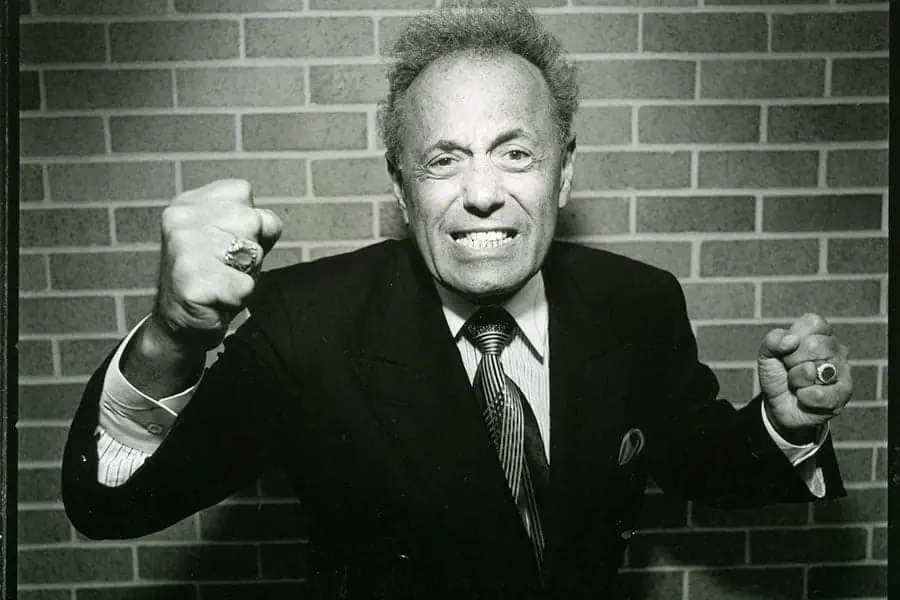
Back then, Lastman was known for his wide-collared shirts, comb-over hairdo and wearing his heart on his sleeve – as well as one-too-many rings on his fingers. His friends called him Curly. And he embraced with gusto his own garishness and new money gaucheness.
He was beloved by North York voters, where he served as councillor and then mayor for 8 consecutive terms starting in 1969.
North York was little more than a backwater then, known mostly as the home of the tavern where William Lyon Mackenzie launched his rebellion in 1837 against the Family Compact. Its politics were a little like the Family Compact, too, with Lastman surrounding himself in his early days as mayor with the usual suspects and their family members on council who’d been running the show for years when no one was looking.
But Lastman would put his popularity to good use to pitch big projects, including converting North York’s downtown into a city centre. Not all home owners in the area would embrace turning the stretch on Yonge between Sheppard and Finch into high-rise central. It was a mess to start, but over time has grown into something resembling a downtown core.
That was followed by another big idea – Lastman’s plan to build the Sheppard subway line from Yonge to Don Mills. It was billed by critics as “the line to nowhere” – and for good reason. The line was chiefly designed to attract development more than it was designed to get people out of their cars and into public transit. It was also supposed to be built with no taxpayer money. Developers were supposed to foot the bill and Lastman rode that promise to another election victory.
But taxpayers ended up paying the price and being saddled with a line that’s still mostly to nowhere and has been siphoning public dollars for years. Decades later, however, development spurred by the project may finally justify its construction. Time will tell. Lastman made up for what he lacked in follow-through with enthusiasm
But his biggest coup may have been getting a public square named after him while he was still alive.
Lastman was a populist before Rob Ford came along and gave it a name. He understood the power of media and how to tap into public sentiment before social media was around and most people got their information on the six o’clock news. He loved being in front of the television cameras.
Lastman was all about giving the people what they want – or at least what he thought they wanted. And as a result he would see his share of controversy, some big some small, including with NOW Magazine when he was part of a drive to have NOW removed from North York City Hall over adult classifieds and ads for sex workers at the back of the paper.
During one council meeting, Lastman would marvel at the various sex acts advertised in the paper. He shrugged that everyman shrug he always shrugged. It provided fodder for some good jokes, of course. But NOW would have the last laugh. When Lastman left for vacation shortly after that debate, his deputy, Howard Moscoe, would present NOW co-founders Michael Hollett and Alice Klein with an award recognizing the paper’s contribution to journalism.
When Lastman arrived in Toronto in 1998 as the amalgamated city’s first mayor, he brought his North York sensibilities with him. He would no longer be a big fish in a small pond and rallying council behind his pet projects would prove a more difficult task than he was accustomed to.
Lastman’s style and conservative politics were out of step with the more sophisticated, lefty political bent of the old downtown Toronto core. There would be a number of embarrassments along the way, like when he expressed reservations about travelling to Kenya as part of Toronto’s Olympic bid because he feared being cooked in a cauldron of boiling water. He wasn’t joking.
But he was also capable of showing political courage. He was reluctant, for example, to take part in the Pride parade after becoming mayor, worried about what it would mean for him politically. But he’d end up showing up with a huge water gun and a good time would be had by all.
He won re-election in 2000 before announcing his retirement before the 2003 run-off. But his would not be a send off befitting a political career spanning almost four decades.
Lastman had become viewed as a pawn for the old boys’ network that used to run this town by fiat. It would ultimately lead to his political demise culminating in the MFP computer leasing scandal that paved the way for a judicial inquiry and the mayoralty of David Miller.
Lastman famously said Miller would never become mayor of Toronto. He was wrong about that.
Lastman’s gift was his gab. But as the years wore on it would also become clear that he was from another political era when mayors were more figureheads than visionaries. Still, his legacy remains writ large in North York. RIP.


