What to know
- An international research team led by a Brock University professor discovered the first known garnet in a Martian meteorite.
- The rare mineral could reveal new details about Mars’ geological evolution, including evidence of more widespread metamorphism than scientists previously believed.
- Researchers say studying minerals like garnet helps reconstruct the environmental conditions that shaped Mars over billions of years, including whether water or habitable conditions once existed.
- Scientists are continuing to analyze the sample to determine exactly how the garnet formed and whether it originated on Mars or arrived via another meteorite.
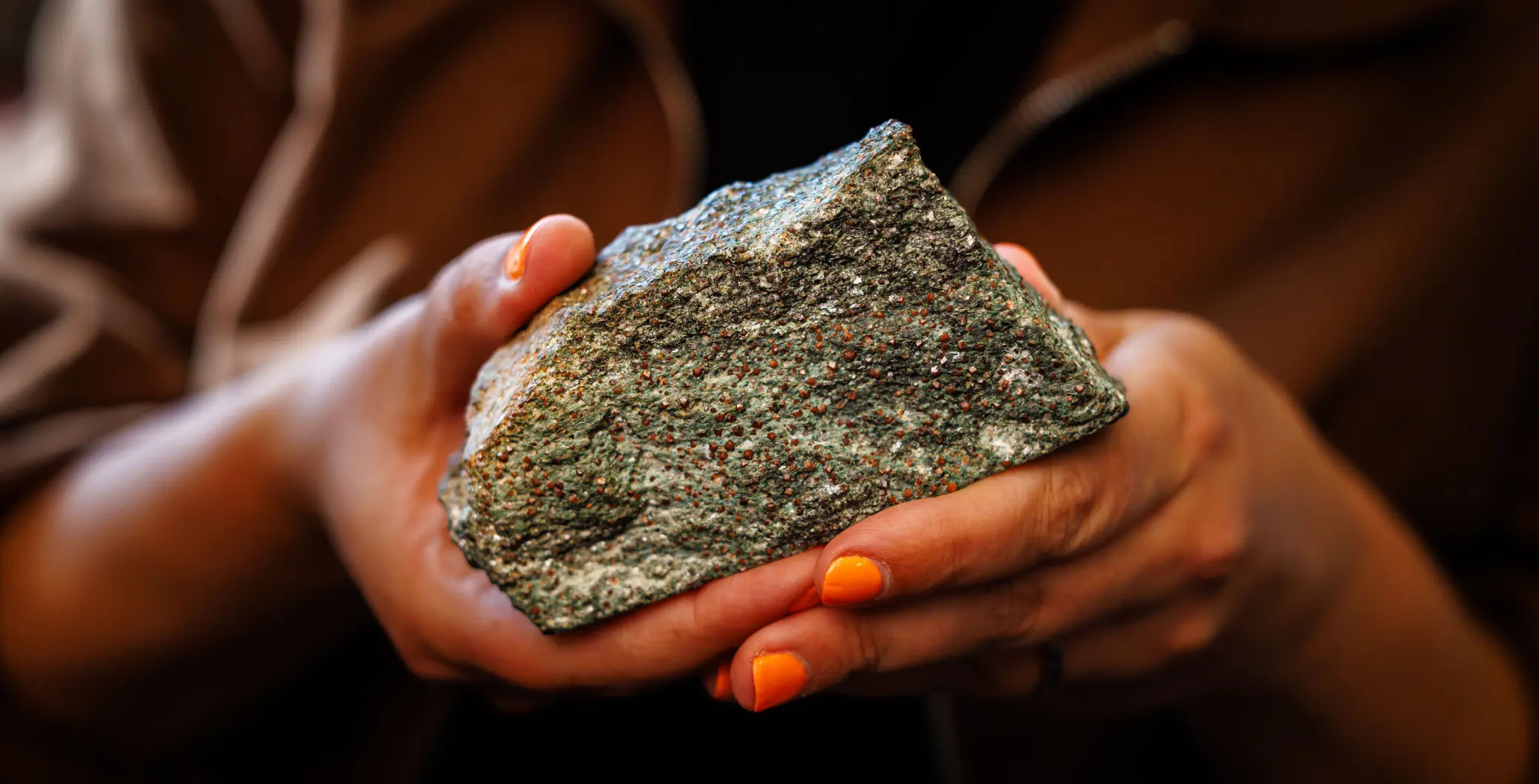
An international team led by a Brock University professor in collaboration with the Royal Ontario Museum (ROM) has found evidence of a rare gem in Mars, and its presence could offer a portal for scientists to learn more about the red planet’s history.
The dark-red gem named garnet is known as the January birthstone, and has been used as an adornment on Earth for centuries. But the discovery of this gem on an ancient meteorite coming from Mars could offer insights into the planet’s 4.5-billion-year history.
How was the gem discovered?
The rare garnet was discovered by an international research team led by Tanya Kizovski, an assistant professor at Brock University, and in collaboration with the Royal Ontario Museum (ROM).
Using specialized equipment, the team analyzed a fragment of a 4.4-billion-year-old Martian meteorite known as NWA 8171. Pieces of this meteorite were discovered across Earth back in 2013, and found to be originally a part of the same rock.
During the analysis, the team was surprised to find a piece of the garnet, which is nothing like other rocks found in the red planet.
“We kind of wrote it off, and then we had this niggling feeling, went back, took a look at it again with some other instruments… and we thought the structure of this particular phase matched garnet, and we did not expect that at all, so it was very exciting,” she told Now Toronto.
Why is this exciting?
According to Kizovski, this particular gem has never been found on Mars before, which makes this discovery exciting for experts.
Part of the professor’s work is analyzing meteorites and rocks found on Mars to get insights on how these minerals could have been formed, including whether they could have been formed in the presence of water or life.
Finding new minerals coming from Mars could be a portal to understanding more about its intriguing history, including whether the planet was once habitable.
“Rocks and minerals, they’re all products of different environmental conditions. So, temperature, pressure, there could be water, there could be life. All these different minerals form in these different environments,” Kizovski explained.
“If you can identify different minerals, especially groups of minerals in rocks, you can identify different environments, so that means we can learn about how Mars’ geology changed…and maybe how its habitability changed over its 4.5 billion year history.”
According to her, scientists currently believe that garnets are formed through shock metamorphism, when a shock wave goes through a meteorite as it’s being ejected from a planet.
However, scientists don’t have substantial evidence of metamorphism in the red planet. This means that the discovery of the rock could also mean there are different types and more extensive metamorphism on Mars than previously perceived.
“We think of [Mars] as mostly being dominated by lava, so igneous rocks, and then sedimentary processes, but not a lot of metamorphism…It’s really exciting in terms of expanding our knowledge of Mars geology and geologic history,” she added.
Garnet still under analysis
According to Kizovski, a team of researchers is still analyzing the garnet at the ROM, as they continue to try to pinpoint the scenario in which this gem could have been formed.
The experts are also looking to find out whether the garnet was completely formed on Mars, or if it was brought to the planet through a meteorite. However, in order to make this discovery, they would need to use laser technology, which has the potential to destroy part of the sample.
“When we’re looking at meteorites, because they are so rare and they’re so precious, we want to analyze them in ways that destroy as least amount of material as possible,” she said.
“We were trying to find more creative ways with other chemical signatures to avoid that, but I think we will have to do that eventually.”


