What to know
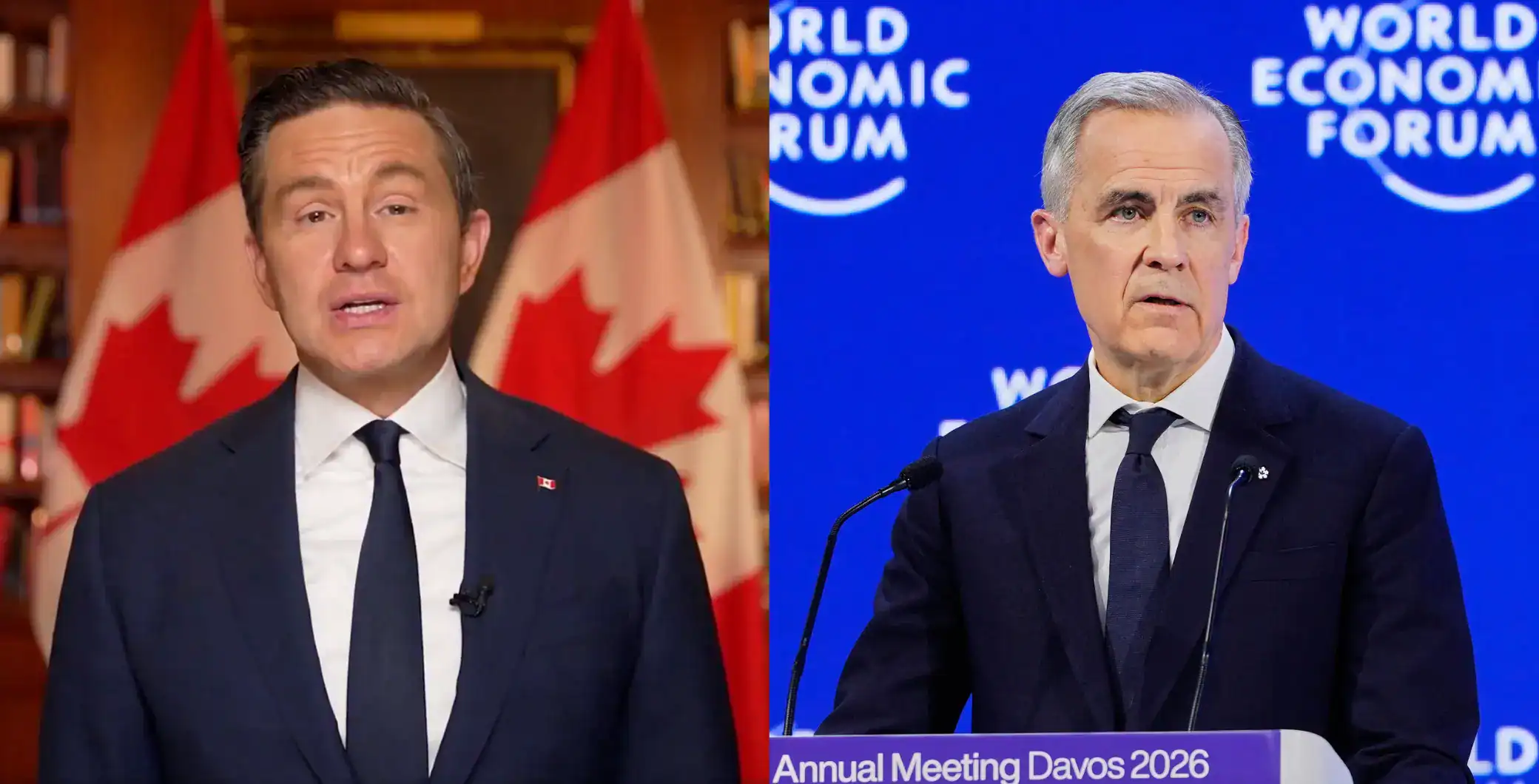
- Prime Minister Mark Carney’s speech at the World Economic Forum received a rare standing ovation and garnered much attention from international media.
- Poilievre says the speech was “well-crafted and eloquently delivered” but that the words must match policy.
- The Conservative Party is proposing the Canadian Sovereignty Act, to “unlock Canada’s potential.”
Opposition Leader Pierre Poilievre says action must follow Prime Minister Mark Carney’s “well-crafted and eloquently delivered” speech at Davos, Switzerland.
“The Prime Minister is right to restate what many have said for years,” Poilievre said, in a video posted to X on Thursday.
“Canada must become more self-reliant, less dependent and work with like-minded countries to advance our interest.”
Read More
In his speech, Carney also called out “great powers” who use tariffs as leverage by “using economic integration as weapons,” adding that countries such as Canada must “live in truth” and not feed into them.
His comments prompted a response from the U.S. President Donald Trump, who claimed Canada “lives because of the United States” before withdrawing his invitation for Carney to join his ‘Board of Peace.’
@nowtoronto U.S. President Trump fired back at Prime Minister Mark Carney after his speech at the World Economic Forum yesterday, saying Canada only "lives" because of the United States. #Davos #WEF #Trump #Carney ♬ original sound – Now Toronto
Read More
Poilievre says Canada should continue its fight against U.S. tariffs but not be consumed with naivety.
“I know it’s tempting to say our relationship with America is over forever,” Poilievre says.
“But here is the reality: We still live next door to the biggest economy and military the world has ever seen. Our trade and security partnership with the U.S. is centuries-old and will outlast one President.”
In his response, Poilievre says Carney’s reference to Václav Havel, a dissident of Czech’s totalitarian communism, was “with great irony.”
“I think [Poilievre] has a point,” Jack Cunningham, international relations professor at U of T, tells Now Toronto.
According to Cunningham, one of the biggest weaknesses in Carney’s speech was that it didn’t place greater emphasis on cooperation with like-minded governments.
The federal government recently struck a “strategic partnership” with China that would see increased trade, cultural exchange, and security cooperation between the two nations.
“Our law enforcement agencies will increase cooperation to better combat narcotics trafficking, transnational and cybercrime, synthetic drugs and money laundering,” the news release reads.
The prime minister’s recent alignment with Beijing came as a surprise, given he had referred to the economic powerhouse and its foreign interference as one of “Canada’s greatest threats.”
In Ontario, Premier Doug Ford has been a vocal critic of the deal along with the province’s auto industry leaders, who are calling it “lopsided.”
Read More
“The one part of Carney’s recent activities that’s troubled me a bit has been his visits to China and Qatar. We should be focused on deepening ties with fellow democracies, and we can do that; there are plenty of them out there,” Cunningham says.
‘There is no magic involved,’ Poilievre calls for action
“A country that cannot feed itself, fuel itself, or defend itself has few options,” Carney said in his speech.
Poilievre says, “So, why can’t we?”
He says Carney has been “lucky” that he’s been “judged by his rhetoric and his stated intentions” rather than by his results.
As he calls for the prime minister to turn his speech into action, Poilievre is proposing a Canadian Sovereignty Act – what he says is “a detailed plan to unlock Canada’s potential.”
In it, he calls for the end to capital gains tax on reinvestments in Canada, streamlining the timeline for permits on nation-building projects, opening up inter-provincial trade, and strengthening the country’s armed forces.
“We need to do things, not just say them,” Poilievre says. “Conservatives are, as always, willing to work with him to turn these words into results.”
He says the Conservative party will introduce a motion to pass the Act next week in the House of Commons.
Though some of the details in Poilievre’s call to action are “actually harder to follow through on than Mr. Poilievre seems to think,” Cunningham says it’s in the federal government’s interest to focus on accelerating economic integration and strengthening Arctic security.
“[The speech’s] significance is going to depend on whether the general principles [outlined in the speech] are followed up with concrete proposals and specific actions,” Cunningham says.