In Canada, there are 338 members of parliament, 751 members of provincial and territorial legislatures and some 25,000 municipal councillors and mayors. Add to that the number of people who ran for office but were not elected, and Max Cameron, the director of the Centre for the Study of Democratic Institutions (CSDI), says there are currently more than 75,000 people across the country who are actively thinking about entering politics.
But Cameron believes that number could be higher, and its cohort more diverse, if only Canadians had a better understanding of the entry points and inner-workings of politics.
“There are so many good people who would never go into politics because they don’t find it appealing. They’re deterred by the idea of living in a fish bowl where everyone is looking at you or not wanting to deal with the attacks,” says Cameron. “But without those good people, it’s affecting the way our institutions are functioning.”
With this in mind, through the CSDI, the University of British Columbia launched a non-partisan “boot camp” in 2013 that teaches participants about the day-to-day life of Canadian politicians at the federal, provincial and city level, as well as experimenting with new concepts to improve our democratic institutions.
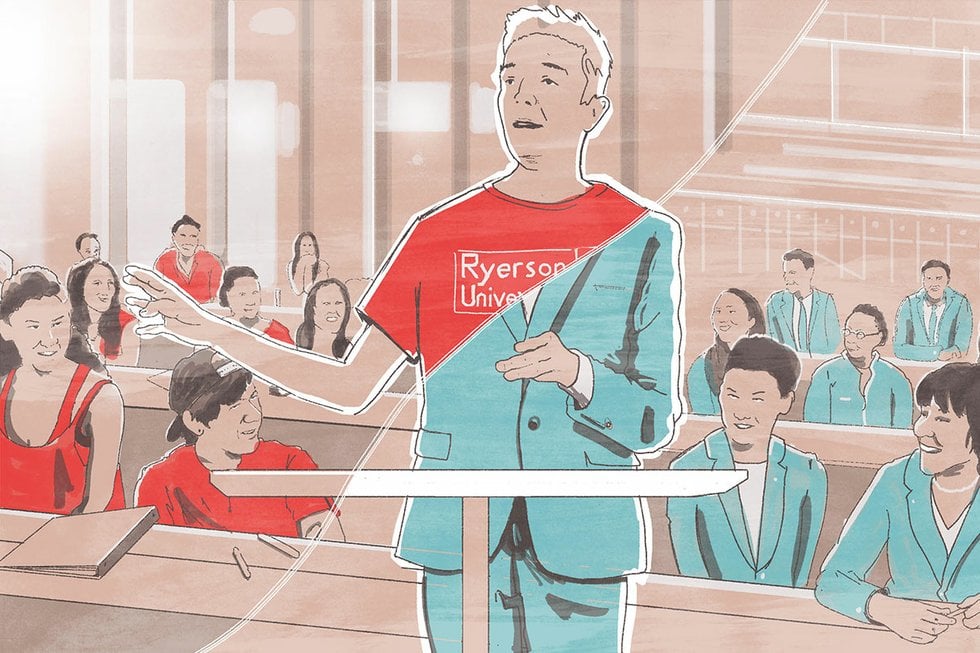
This spring, Ryerson University’s Faculty of Arts is launching the Institute for Future Legislators Ryerson (IFLR), a program modelled after CSDI’s boot camp. Applications are now open and are due by April 1. The program, which costs $1,200, runs over three weekends in May and June and is open to anyone.
Unlike most professions, there’s no concrete training for politicians. The boot camp prepares the participants for the real world of politics, from learning the basics of parliamentary practices and procedures, to how to answer media questions, to how to pass legislation and work with other political parties. The participants also get advice from elected officials, scholars and political journalists who offer mentorship and share their experiences. So far, former NDP MP Peggy Nash and journalist Martin Regg Cohn are confirmed for the Ryerson program.
During the final weekend, participants will head to Ottawa for a mock parliamentary session at the House of Commons. The students will break into political parties, run caucus meetings and try to pass legislation, while also keeping up to date on breaking news and fielding questions from journalists.
Although some of the UBC program’s alumni have gone onto become politicians – like Heather Sweet who was elected to Alberta’s legislature, and Allison Patton, who is on Surrey’s city council – others have gone onto become elected officials in unions or as civil servants. “Whether a participant decides to run afterwards or not, they’ll know much better what the job of a parliamentarian entails,” says Cameron.
Hailey Graham participated in the UBC program in 2013 with political aspirations. “Politics is definitely for me and I think the Institute helped me realize it’s not for me right now, but one day,” says Graham, who is currently in law school in Vancouver.
One of the most enlightening experiences for Graham was learning how to become more self-reflective, something that’s prompted by the instructors throughout the program.
“One of my passions is to have more women in politics, so part of the reflective piece for me was thinking, ‘Who’s taking up space?’ or ‘Who is putting themselves forward into leadership positions right away?’ and ‘How do those people end up getting elected?’” says Graham. “The boot camp highlights those inconsistencies [between different groups of people].”
Cameron says integrating the self-reflective element – something the CSDI picked up from UBC’s medical school – is a way for participants to become better politicians. “It gives them the tools to listen, be more empathetic, find common ground and be able to work with people across party lines,” he says.
Instructors at both Ryerson and UBC’s programs believe that the boot camp is also an opportunity to help elevate groups who have historically been underrepresented in politics, like women, people of colour and LGBTQ- communities.
“For people who haven’t had a political voice or have been marginalized, [IFLR] helps them find ways in which they can articulate their own concerns and do it in the legislature,” says Pamela Sugiman, dean of Ryerson’s Faculty of Arts.
Cameron agrees.
“If you don’t encourage the people who are underrepresented to acquire the skills to be effective statespeople, then politics will be dominated by the same families and social classes as always. Part of our hope for the boot camp is to encourage more inclusion.”
@SamEdwardsTO