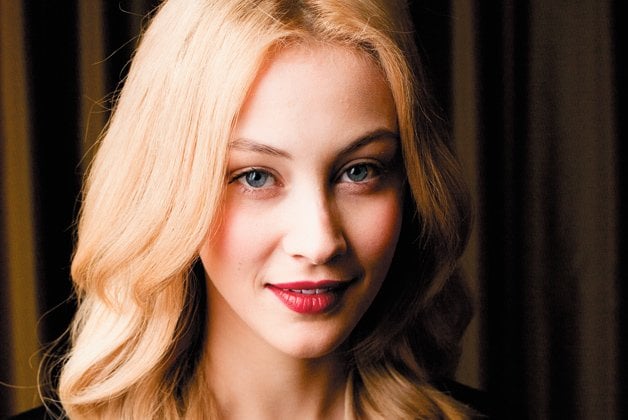
Last fall, Sarah Gadon was Michael Fassbender’s intriguing, unknown screen partner in David Cronenberg’s A Dangerous Method. A year later, she’s become the face of young Canadian cinema, having carried the flag to the 2012 Cannes Film Festival as a co-star in both Cronenberg’s next feature, Cosmopolis, and Brandon Cronenberg’s debut feature, Antiviral.
(Call her an overnight success if you’re willing to ignore the decade she put in as a young actor and voice artist on everything from Ruby Gloom and Total Drama Island to Being Erica and Happy Town.)
And now she’s back at the Toronto Film Festival with Antiviral, in which she plays a celebrity figure named Hannah Geist, adored by the citizens of a strange alternate Toronto for her poise, her beauty… and her diseases.
In Antiviral, we’re introduced to your character through billboards, posters and ads well before we ever meet her in the flesh. (All the Geist images were shot by Caitlin Cronenberg.) How did that collaboration work?
I think what makes Hannah [seem] so accessible is her ability to connect with people, and that comes across in Cait’s photography because it’s not quite perfect. There’s a lot of humanity in her images. When I signed up to do the film, it was important to me that she’d be doing so much of the image creation with me as well as with Brandon. We did all the photography in pre-production, and it was interesting: this character doesn’t speak a lot, but she has a huge role to play. Our photography contributed to the landscape of the film. In this weird way, she’s a big part of the setting.
Can you elaborate on the world of Antiviral?
It’s kind of that postmodernist, dislocated idea of “Where does this actually exist in time?” I like that it’s not futuristic and it’s not exactly current, but I think that’s true of a lot of the ideas it’s exploring, too.
That’s true. The movie’s core concepts – beauty, celebrity, desire – aren’t exactly new.
They’re part of a discourse that’s been going on for centuries.
Antiviral makes a point of keeping Hannah Geist a cipher we’re not supposed to know who she really is. Did you create a history for her, just for yourself?
Well, I do build my own backstory as an actor. It’s important to know where your characters have come from in order to know where they’re going – in order to exist in that state of being. But it’s important that people don’t know her, because that’s the whole idea of the celebrity obsession. It’s a group hallucination that we all partake in. [Famous people] are there for you to project on to.
But there’s a vulnerability people connect with in Hannah that I wanted to put across in the images and the film. When you fall in love with favourite movie stars, it’s not because they’re movie stars and unattainable, but because they show you sides of themselves that are extremely personal. That’s what I wanted to bring to Hannah.
Did you take any inspiration from real-world models or actors, contemporary or otherwise?
At the very end, when she’s doing her commercial, Brandon and I talked about emulating beauty ads – that kind of false sincerity addressed to the audience. We wanted to capture that sense of a large drug company appealing to the everyday person. When I created my image board for Hannah, I drew from a lot of contemporary magazines, including several models and actresses. But I didn’t want to go after just one person she needed her own stand-alone identity.
It must be surreal for you, given the year you’ve had, to portray a character who simply exists to be photographed, filmed and exploited. It’s almost a nightmare version of your own career.
One reason I wanted to do the film was to actively participate in constructing [Hannah’s] image. When Brandon and I talked about the film, I thought, “I’m not interested in being a female body fetishized as an image that’s not something I’m looking forward to, not something I think is very redeeming about classical narrative cinema. But if you and I want to create this person together….” That control over her image I had as an actor outside of the film was important to me. And it extended beyond just, you know, “I want to decide this” and “I want to decide that.”
How so?
It was a contractual thing. “I want 75 per cent contractual approval. I want to know what photographs they’re using of me.” That’s something all actors are conscious of. How can you not be? If you’ve seen anything you’ve ever been in, you’re aware of your image. You have to be – that’s the self-reflective nature of the industry.
But there’s a lot more control and technique involved that people aren’t aware of because of that veil of illusion. It’s particularly important for a young woman to be in control of her image – to a certain extent. I mean, there’s only so much you can do, because people take photos with you and then all of a sudden they pop up all over the place, they’re completely out of context and you have no control over how they’re used.
What was so appealing about Antiviral was exercising so much control over how Hannah was portrayed.
And she is, ultimately, as human as anyone else in the film. Maybe more so.
Yeah. Behind these intensely famous people are very vulnerable, highly scrutinized, individual human beings, I wanted to show that in her character.