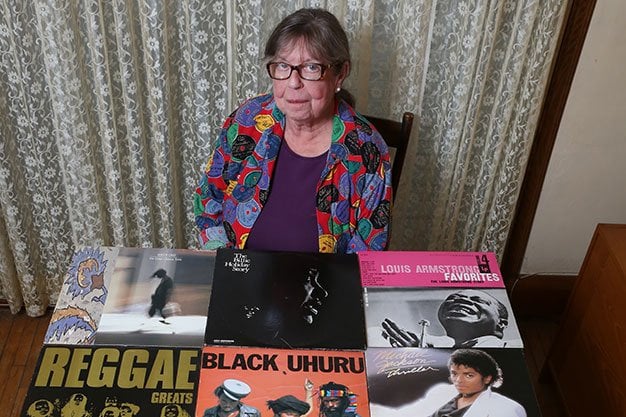
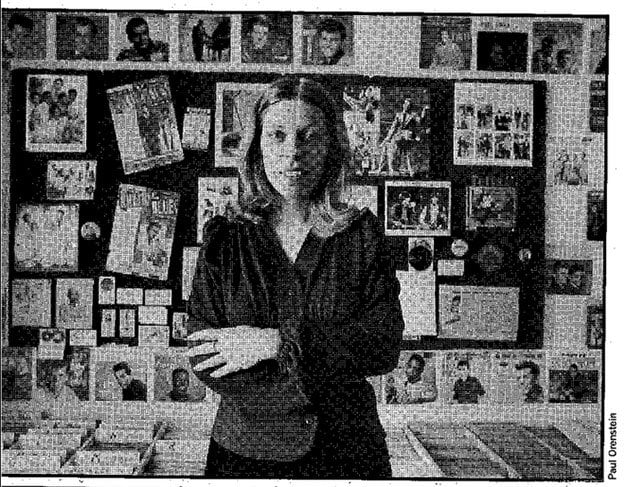
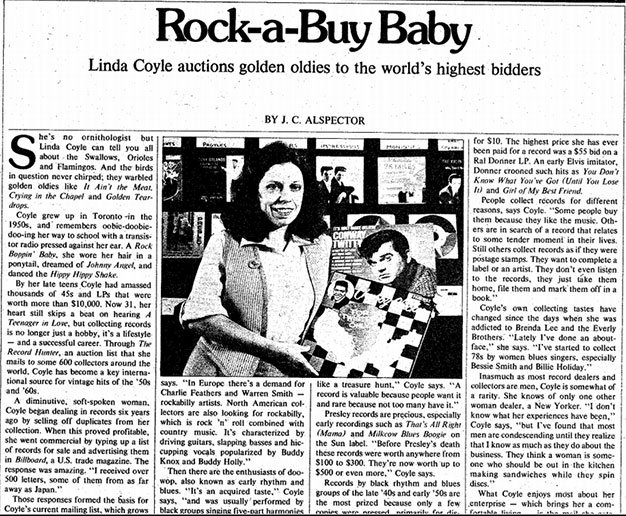
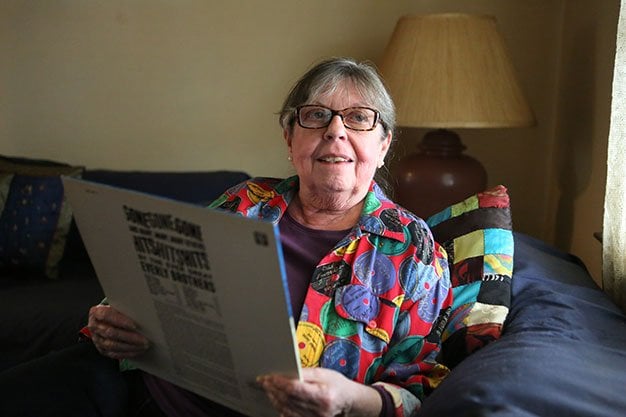
When Linda Keele met her future husband and business partner, Don, in 1971, she had already established herself as the first used record dealer in Canada. Not that he, or anyone she was buying records from, knew anything about her side business.
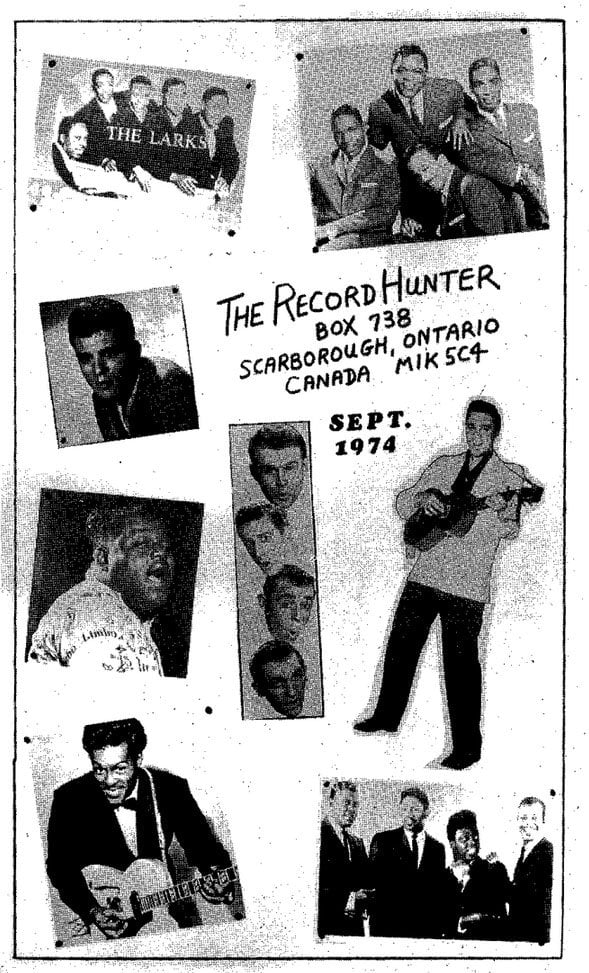
“I called myself The Record Hunter,” she says, smiling.
Driving all over the city in a Corvair, a car famous for having an engine in the back predisposed to catching fire, Linda was buying up old 45s for 25 cents each from people’s old collections and record bars – mini-record stands within appliance and furniture stores.
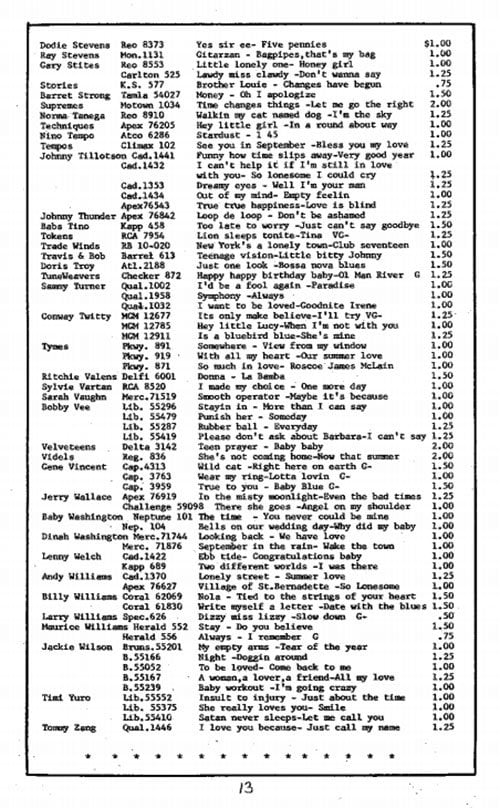
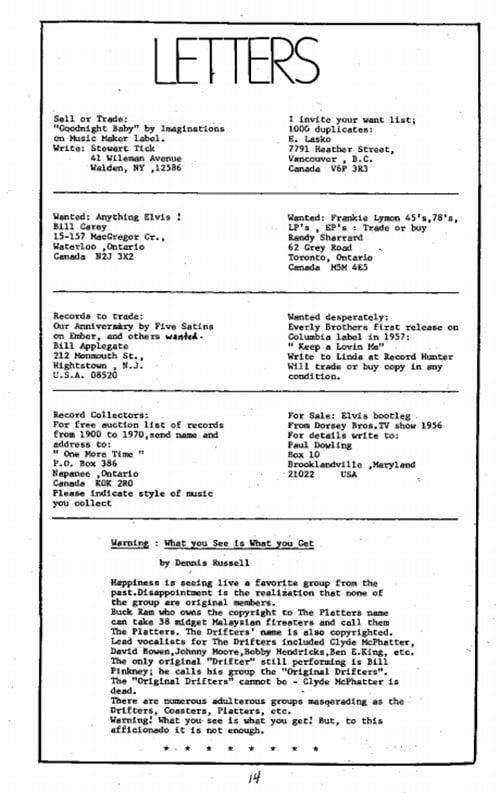
What had begun as a search for the beloved music of her early teenage years – The Everly Brothers, Bill Haley, Little Richard, Ricky Nelson, Buddy Holly – had evolved into a lucrative side business that supplemented her income as a girl Friday at Sweeney Electric. Linda was selling used records worldwide by homemade, mail-order catalogue. At first she sold them at a mark up, and then to the highest bidder.
At first, Don was just another seller, with antiques being the main focus of his store at Queen and Parliament. After meeting Linda, Don ditched the antiques and in 1974, because of popular demand, they sold 45s, LPs and 78s exclusively out of the newly named Don’s Discs. (Legend has it that Dan Ackroyd, who operated a speakeasy at 505 Queen East at the time with fellow Second City member Marcus O’Hara, actually came up with the name).
On warm days, the Keeles and their neighbouring shop owners would get beer and shoot the shit outside on the sidewalk.
“The environment was charged with fun,” Keele remembers. “Saturday afternoons it was like a club. Everyone came, and maybe they didn’t buy records, but they were just happy to be there. Maybe they bought something and maybe they didn’t.”
On Record Store Day this Saturday (April 18), you may still be able to experience what’s left – or what has evolved – of that community. Just on the other side of the Don Valley, Trevor Larocque and his wife, Maude Fallon-Davesne, are celebrating their first Record Store Day at their recently opened Tiny Record Shop (804 Queen East).
Like Don and Linda’s store, it’s part of a small community of shops, with Token, a gift store, in the front and a door that connects directly to vintage clothing shop Common Sort next door.
So far, the store has hosted three in-store performances, with Born Ruffians, Elliott Brood and the Rural Alberta Advantage taking the “stage” – the raised changing area at the back of Common Sort – in the last year. Larocque, who is also a founder of Paper Bag Records, says there is a thriving community of record lovers in the area. They just never had anywhere to go until now.
“Riverdale is an area that’s changing right now,” he says. “[The Tiny Record Shop] is the perfect addition to the neighbourhood. There are a lot of young families and they wanna have those types of things at their fingertips. We have record stores in other neighbourhoods, but people don’t want to travel. They still want to buy music and go to shows, but don’t have time to go. We filled the void.”
But it would be misleading to suggest that things haven’t changed. The most glaring difference, of course, is the cost of doing business.
In the ’70s, the Keeles paid just $80 a month to rent out the Don’s Discs space. And their landlord would bring them donuts when he collected the rent.
And in the last 40 years, record collecting has gotten a lot geekier.
When Linda and Don would drive to Buffalo to drop $100 or so on records, people would be lined up outside their shop, waiting to find out what they’d picked up.
“I guess it was a different kind of thing,” Keele says. “[Don] would play records and guys would say, ‘I’ll take that, I’ll take that, I’ll take that.’”
There was no internet, no Ones to Watch in NOW Magazine, no Pitchfork’s Best New Music. People just bought what they liked, and the only way they could suss that out was by listening to it.
Now, from eBay to Discogs, vinyl collectors and dealers are fiercely competitive, leaving some of us wondering if they even like listening to what they’re buying.
And Linda’s not the only woman in the “club” any more either. Last month’s record show, organized by the Keele’s son Aaron of The Record Guys, was proof of that, with plenty of female record fans drooling over vinyl.
Not that her gender has worked against her. Looking back at career in retirement (Don and Linda sold the stores in 1986), Linda thinks more people responded to her ads and sold her records for cheap because she was so non-threatening.
“I think that’s why I made out like a bandit,” she says. “It wasn’t ‘Call Peter or Call Bob,’” she says, referring to her ads. “‘It was Call Linda.’”