Mark Carney has officially stepped in as the new Prime Minister of Canada this morning. Here’s what you need to know.
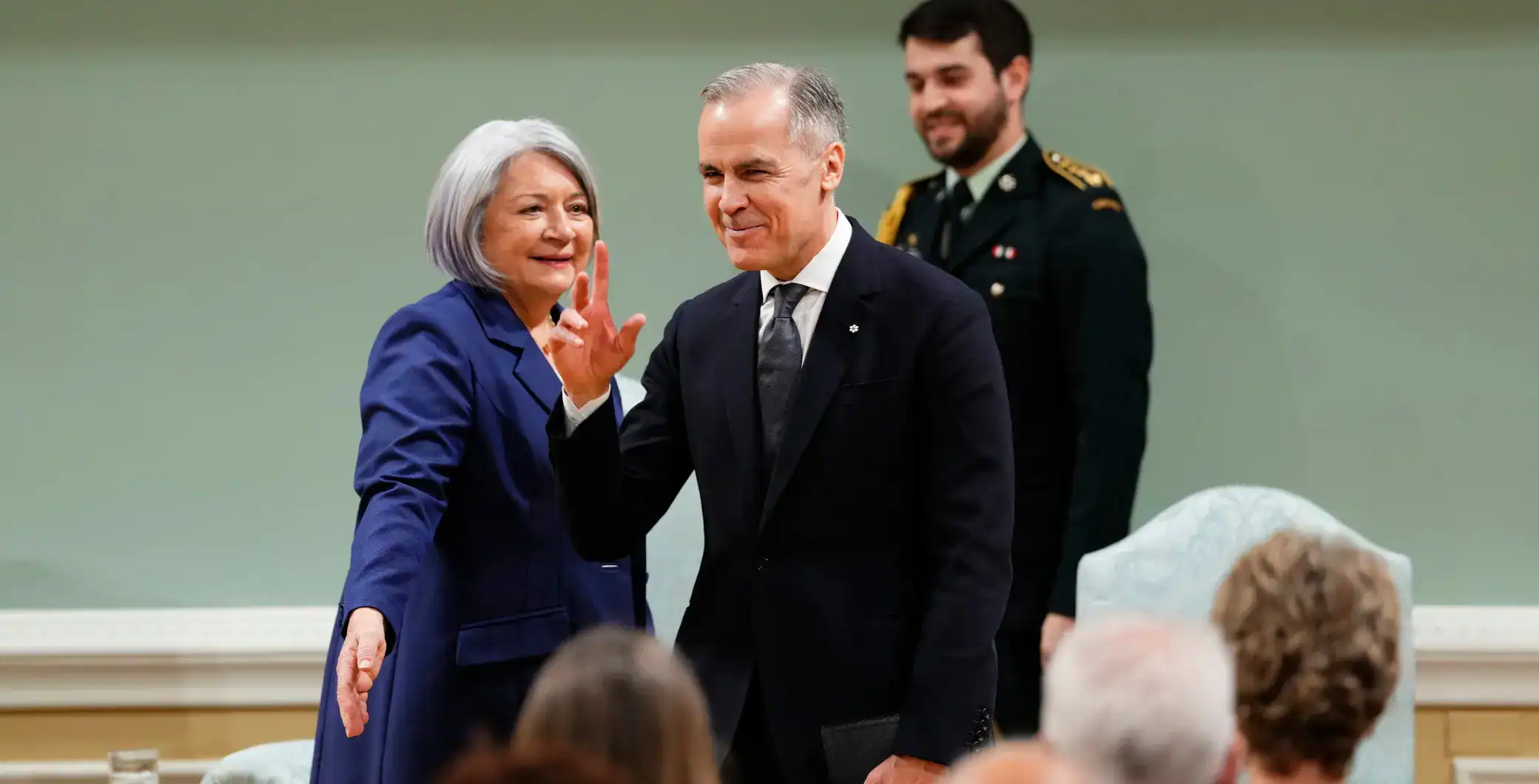
Carney was sworn in a ceremony at Rideau Hall in Ottawa by Canada’s Governor General Mary Simon, and has presented his cabinet who also recited their oaths before Simon.
After almost a decade as prime minister, Justin Trudeau officially handed in his resignation in a private meeting with Gov. Simon, after he stepped down as Liberal party leader in January. This sparked a Liberal leadership race where Carney won by a landslide last weekend.
Read More
Carney arrived with his wife, Diana Fox Carney, at Rideau Hall for the ceremony, and told reporters that his government will focus on action.
“We’re a very focused government, focused on action. We’re going to get straight to work,” he told reporters as he entered the hall.
At this time, it is still unknown whether Carney will be calling a federal election in the next few weeks.
Speaking with reporters after the ceremony, Carney said he will be calling elections sometime before November, as the cabinet still has to meet to make certain decisions.
Now Toronto spoke with Dr. Elizabeth McCallion, a political science professor at the University of Toronto, who believes Carney will be calling an election “fairly soon” given that the Liberals have been doing well on the polls recently amid the federal government’s response to U.S. tariffs on Canadian goods.
“Given the liberal party’s really strong performance, relatively strong performance in the polls right now, it’s understandable that Carney might want to capitalize on that and call an election when he has the support of Canadians, rather than waiting a few months when the support might [decline],” she said.
The professor also mentioned that calling an election early might be an important step when dealing with Trump’s administration, given that Carney might lack the image of a strong leader since he currently doesn’t hold a seat at the House of Commons.
“Carney needs a strong mandate for Canadians to deal with Trump. And I think it would be difficult for him to run as the prime minister who has never won a community election and does not have a seat in the House of Commons. His priority will be getting that mandate, getting that seat.”
NEW CABINET SIGNIFICANTLY SMALLER
Carney’s cabinet is significantly smaller than Trudeau’s, with 23 ministers instead of 37 like the last Liberal government.
Meanwhile, 18 ministers from Trudeau’s cabinet will not be a part of the new government, bringing some new names to the scene.
Rachel Bendayan replaces Marc Miller as the new Minister of Immigration, Refugees and Citizenship, while Kody Blois steps in as Minister of Agriculture and Agri-food and Rural Economic Development.
The new cabinet also includes known names like the former finance minister Dominic LeBlanc, who is now the Intergovernmental Affairs and International Trade minister, and former innovation Minister François-Philippe Champagne who took over as Finance Minister.
Another minister that is now filling a different role is former Diversity, Inclusion and Persons with Disabilities of Canada Minister Kamal Khera, who is Carney’s new health minister.
Some ministers were maintained, including Public Safety Minister David McGuinty and Foreign Affairs Minister Melanie Joly, who will be sworn in later as she wasn’t present at the ceremony.
Chrystia Freeland, who also ran for Liberal leadership along with Carney after resigning as Trudeau’s Finance Minister earlier this year, also makes part of the new cabinet as the Transport and Internal Trade Minister.
“Canada’s new government is changing how we work, so we can deliver better results faster to all Canadians,” Carney said to reporters. “Canada’s new government will be action-oriented, driven by a smaller but highly-experienced team made to meet the moment we are in.”
According to the new prime minister, his cabinet will mainly focus on protecting Canadians from “unjustified foreign trade actions” and growing Canada’s economy by reducing public spending.
McCallion explained that the decision to reduce the cabinet reveals the efficient nature of the current government, which is currently dealing with the trade war while trying to maintain the functioning of regular services for Canadians.
“This is supposed to be like a wartime cabinet, right? It’s not business as usual in the government, and there will likely be an election soon. So, the cabinet is kind of there to govern in caretaker mode between now and when the election is. And they have a strong role to play in dealing with negotiations.”
“Canadians don’t want to see kind of a loaded government right now. They would want to see a more narrowed down cabinet that’s really ready to get to work, and that’s focused and [that] the ministers have clear, defined and specific portfolios that they’ll be working on,” she added.
NEGOTIATING WITH TRUMP
Carney made it clear that protecting Canadians from the effects of the tariffs is a priority for his government and referred to Trump’s remarks about Canada becoming America’s 51st state as “crazy.”
“We will never, ever in any way shape or form be part of the United States. America is not Canada,” he stated.
“The president is a successful business person and deal maker. We are his largest client in so many industries… and clients expect respect and working together in a proper commercial way.”
McCallion believes that one of the reasons Carney was elected Liberal leader was because the public believes he will stand up for Canada amid Trump’s tariffs and threats.
“People see him as level headed and ready to take on a fight. So, hopefully then he will do what the Liberal Party members elected him to do when they chose him as leader, which is to stand up for Canada and go into negotiations like prepare to defend Canadian interests,” she said.
But the professor also pointed out that while Canadians are currently focused on Canada’s response to Trump’s tariffs, the federal government still has the important mission of keeping things going at home.
“They still have to run the rest of the country. They still have to make sure that services are delivered to Canadians, and so they have a role to play there. That’s not just focusing on what’s going on internationally, but taking care of Canadians at home,” she said.