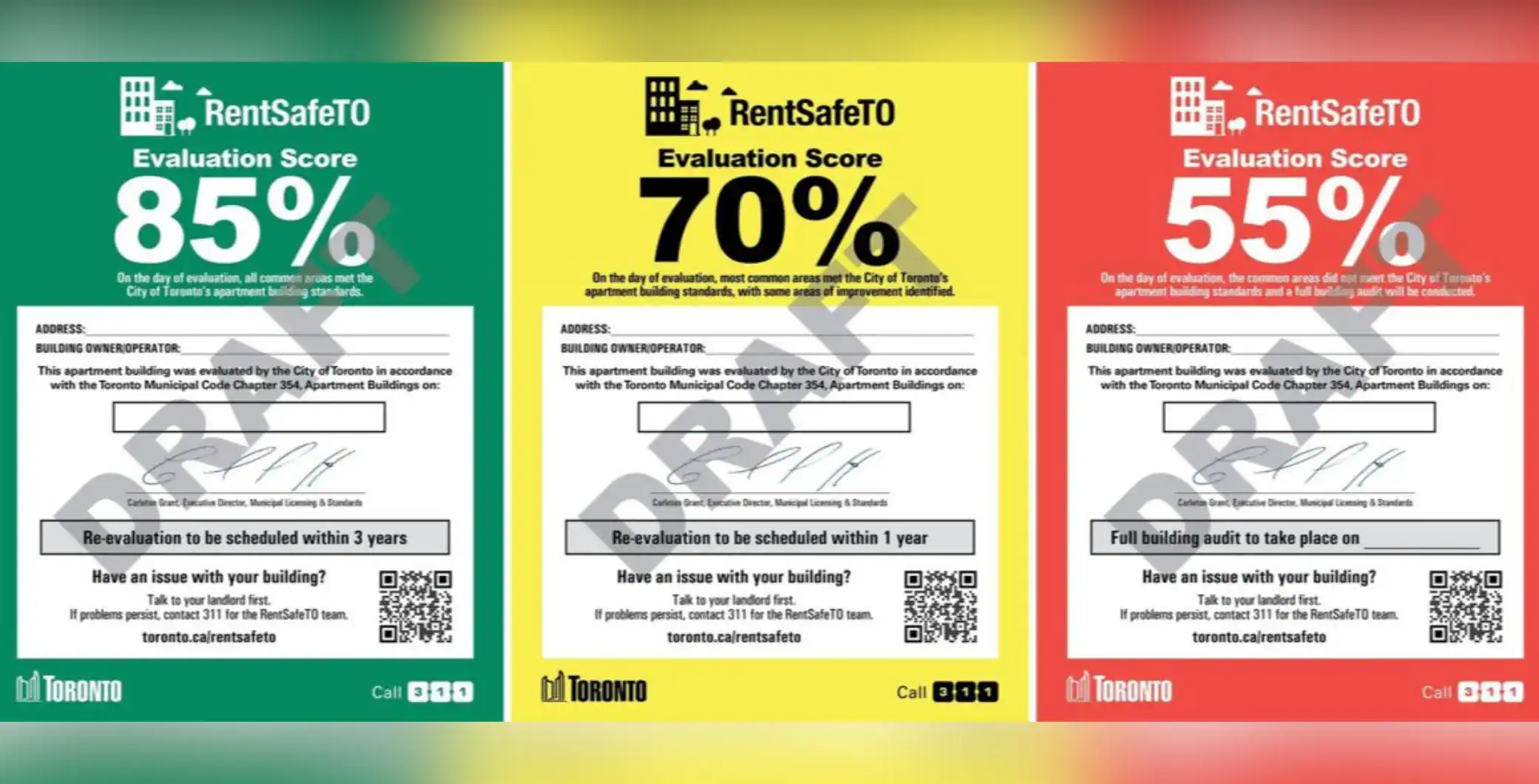
City councillors will be voting on a motion to implement colour-coded signage for Toronto apartment buildings to reflect their compliance with maintenance standards, and residents have mixed opinions about it.
Similar to the DineSafe program, the system is calling for green, yellow and red signs to be easily visible in front of buildings to reflect landlord violations.
In 2017, Toronto launched its RentSafeTO program, which aims to guarantee that building managers comply with maintenance standards under the Apartment Building Standards.
According to the program, landlords of three or more storey buildings or 10-plus units will be required to register and pay a fee, and receive a score from city staff that reflects factors like maintenance, pest infestations, mold, and heating systems. Scores go from 0 to 100 for apartment buildings, except for condos or basement units, and are available on the program’s web page.
A few years ago, city council also voted on a similar colour-coding system, which didn’t pass due to concerns about buildings being stigmatized.
But coming July 23, a new motion led by Coun. Josh Matlow and Coun. Chris Moise will re-introduce the idea for colour-coded signs to be displayed in apartment lobbies.
In a statement to Now Toronto on Wednesday, Matlow said that the city’s current scoring system seems to not be enough incentive for landlords to fix issues that affect tenants, “leaving too many Torontonians [living] in homes that have pests, mold, appliances that don’t work, and inadequate heat.”
“As with the successful DineSafe program, colour-coded signs on rental buildings will act as a strong incentive for landlords to do necessary repairs, validate renter concerns and empower them to assert their rights, and provide prospective renters with important consumer protection information,” he said.
While I was proud to introduce Rentsafe to protect tenants’ health and safety in 2017, it’s important to recognize that it’s not as effective as it needs to be. It’s time to move forward with colour-coded signs. The current % based system gives points for keeping the lobby… pic.twitter.com/hjIxJL9gnq
— Josh Matlow (@JoshMatlow) July 9, 2025
The motion is also being supported by several tenant rights advocacy groups, including the York South—Weston Tenant Union, ACORN, the Federation of Metro Tenants Association (FMTA) and NoDemovictions, which the councillor say are frustrated over residents being forced to live with long-standing issues.
FMTA Executive Director Yaroslava Avila Montenegro tells Now Toronto that the association has been supporting the program since its original introduction in 2017, with the support of many local tenants who also think the move would be helpful in reinforcing the rules.
According to her, the signs could make it easier for tenants to mobilize action to advocate for better building conditions.
“These RentSafe signs posted in every building in every neighbourhood can actually help us organize, not only keep landlords accountable, but also to make sure that managers at the city level do their job to be able to enforce the [bylaws],” she said.
“I think that having the signs up is going to be a mechanism, again, to be able to mobilize and to be like, ‘Hey, we [want] a building that’s not a bad rating,’” she added.
Montenegro says that FMTA is also working along other groups of tenants who support the motion, including residents of a building at 1501 Woodbine Ave., which has faced frequent maintenance issues.
“There are huge maintenance issues right now in the building, including concrete pieces of bridge and concrete that are falling off the side of the building. So, the foundation may be compromised. The problem being that because of the city’s lack of enforcement, it took 10 months to be able to get a full building on it again… and they’re still waiting. So, what we want to see is the RentSafe program to be fully enforceable,” she said.
The director said that despite concerns, she doesn’t think that the signs would stigmatize certain buildings, but rather the property managers themselves. Montenegro also said she has not heard concerns about stigmatization directly from tenants, and that most are supportive of the move.
Similarly, Matlow says that “landlord lobbyists” who oppose the program are the ones bringing up the concerns, while most renters have been supporting it.
“Renters have consistently said that pests and mold are stigmatizing, not a sign. Requiring landlords to put a City of Toronto colour-coded sign outside a building validates the conditions renters are experiencing inside,” he said.
The councillor says that Toronto Mayor Olivia Chow, who wasn’t present when the first motion was delivered in 2017, has agreed to second the motion. With her lead along with support from other councillors, he is expecting the motion to be approved at the Member’s Motion at Council later this month.
Meanwhile, Torontonians online seem to have mixed opinions about the new proposal.
Some residents are supportive of the move, and think that it would not cause issues with stigmatization.
“As a renter, I am all for a big red sign on my building. Stigmatization was just an excuse to do nothing,” one Reddit user said.
“If this is intended to also inform prospective tenants, having a ‘Modernity’ factor or separate disclaimer would be a good idea. I would imagine that certain tenants would like to know how the building has been maintained and upgraded over the years,” another user added.
“If that’s the only way to keep new buildings in decent shape then it’d be a good thing to do. It’s not like the bad buildings are not already known,” a different Redditor weighed in.
On the other hand, others are worried about the repercussions of the decision, considering that many who already live in the buildings cannot choose to move.
“I like the idea, but people have a choice to eat or not at a restaurant… not everyone (by a long shot) has a lot of choice in where they live,” a Reddit user commented.
“And it would [increase stigmatization]. If somebody lives in a ‘green’ building, whether they want to or not, they’ll look down on someone in a ‘yellow’ or ‘red’ building,” another user said.
“They could put the system only online? That way it’s not apparent to current residents everyday and visitors who come by but if you were researching about living there you’d see it,” a different user suggested.