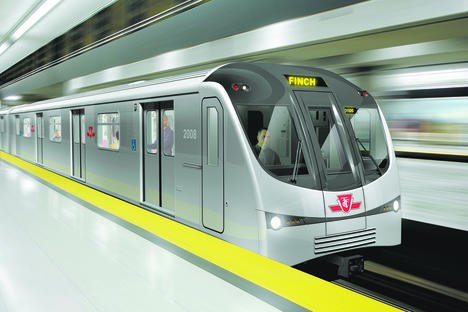
Remember when we used to talk about how to improve the city?
Today all we seem to discuss is how to dismantle what we’ve built together over the last couple of decades. Sadly, the conversation around the TTC is no different.
One gets the sense that the current administration is intent on taking us back to the time when transit was run as a business, and improving service wasn’t a consideration because locals had no other options.
Last Friday, the TTC met to consider how to deal with a budget shortfall created by the regular rising costs of fuel prices and electricity as well as parts, and the inevitable arbitrated wage increases.
But to make matters worse, the city has proposed cutting its subsidy to the TTC by $46 million, from $429 to $383, although ridership continues to grow by upwards of 2 to 3 per cent. In total, this leaves an $85 million hole.
The Commission, in turn, voted to cut $20.9 million from service by changing the loading standard from 48 riders a bus (32 seated, 16 standing) to over 60, meaning more crowding on already jam-packed routes.
The catch here is that service cuts may actually yield only $13.7 million, because bad service means some riders (the TTC estimates about 3.8 million of them) will avoid transit altogether, resulting in a $7.2 mil loss in fares.
As demoralizing as all this seems, there are smart ways to prevent the gutting of the system, and even increasing service. One simple solution would be to have the province go back to funding 50 per cent of the operating deficit, as was done until the mid-1990s. In other words, riders would fund 68 to 70 per cent of the total operating budget of $1.507 billion from their fares (as they do today), and the city and province would split the remaining 30 to 32 per cent.
The province currently pays zero dollars toward operations, though it has announced cash for capital budget items like a Spadina subway extension and the Eglinton Cross-Town. Whether or not stable provincial money is a possibility has a lot to do with the outcome of the election October 6.
But even without that, the Commission’s own figures knock that $85 million gap down to $20 million if you add up the savings, evident in the ledger, from lower diesel prices, a legal settlement that didn’t come to pass, the delay in filling vacancies, plus boosts from higher ad revenue, reduced benefits costs and absenteeism, and staff cuts.
To close the remaining shortfall, TTC staff (the Commission put off this decision) are recommending a 10¢ fare increase, a roughly 4 per cent rise, which, while above normal inflation, is in line with inflation in the transportation industry. This would suffice to make service cuts unnecessary.
No one wants fare increases, but many are willing to swallow them, studies show, to ensure predictability and comfort. An absolute guarantee that service wouldn’t suffer would require a 15¢ hike, netting about $42 million, $12 million more than a 10¢ increase. This, along with $5 to $6 mil in additional savings, would be enough to actually expand service, cutting wait times and lessening crowding.
Where would this $5 to $6 mil come from? First, the TTC could raise parking charges at some of its lots. A modest increase would bring in $500,00 to $750,000. The TTC should also improve route management through the use of technology (now available with GPS systems) and a few more route supervisors to aggressively manage delays and bunching. Buses cost around $370,000 a year to operate, and if bunching is reduced, fewer vehicles can carry more people.
If 10 buses’ worth of service (out of around 1,700 in the system) were “saved” through better management, that would be the equivalent of $3.7 million. Likewise, over the coming years the TTC should invest in energy efficiency programs a lot of these changes pay for themselves in only a few years. According to previous estimates, this could save $5-mil-plus a year.
Other ways to pare costs include converting systems to the cloud computing used at other transit agencies, which, based on experience, could result in an estimated $1 to $2 million a year in savings. As well, the contracting in of engineering, legal and IT functions has already netted in excess of $15 million over the last five years, by hiring staffers to replace outside consultants costing three times as much.
The TTC will need these and other ideas in the years ahead when it faces increasing pension, salary and fuel costs, not to mention the millions needed annually to run Presto and the $50 to $60 million lost to yearly inflation. The financial challenges are great, but the current cuts are more about a philosophy hostile to public transit than a necessary budget exercise.
TTC totals
Operating budget $1.507 billion
2011 shortfall $85 million, including $46 mil in cuts proposed by the city
Amount already accounted for in savings $65 million
Difference $20 million
If fares are raised 15 cents TTC gets another $42 million
Plus Creative savings of $5 to $6 million
Equals Expanded services, not cuts
Adam Giambrone is the former chair of the TTC.
news@nowtoronto.com