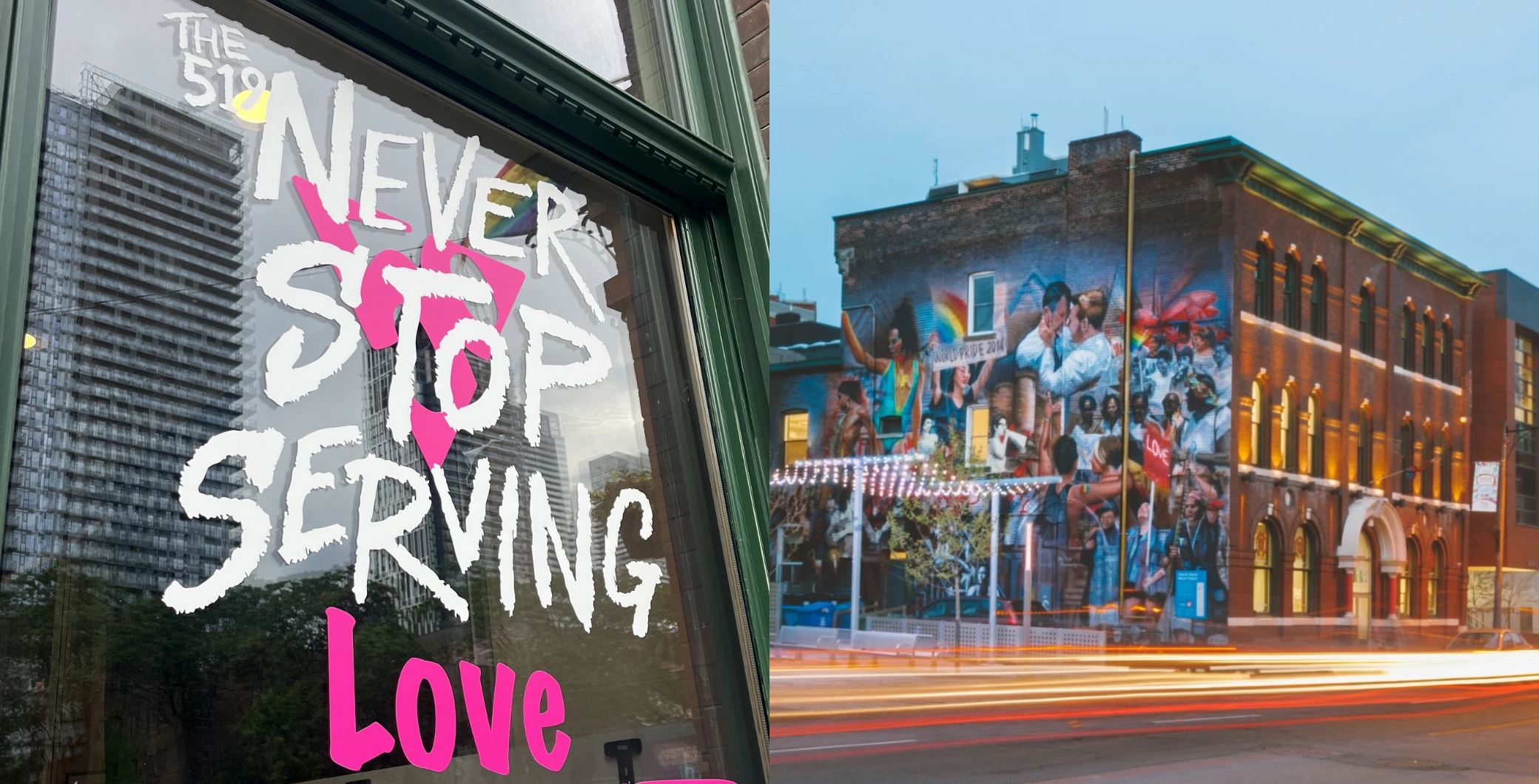
Before it became the heart of Toronto’s Queer Village, The 519 was a building destined for demolition.
Fifty years later, the community centre is celebrating a milestone anniversary while reflecting on how a grassroots campaign to save one Church Street building helped shape generations of 2SLGBTQIA+ activism, advocacy and community in Canada.
One of Canada’s most important 2SLGBTQ+ institutions, The 519, is a cornerstone of Toronto’s Church-Wellesley Village. Named for its location, 519 Church Street, the centre’s team tells Queer & Now that their story begins in 1975 when the City of Toronto purchased a formerly condemned building after residents protested against its demolition.
“The 519 really was sort of founded in an act of protest, so the building itself was slated for demolition in 1976,” explains Roxanne Duncan, project coordinator for the 50th anniversary.
“It was the local community that came together and convinced the city not to demo it, but actually to purchase it, and to return it to community use, and make it a community center.”
Becoming the heart of Toronto’s Queer community
The site officially opened as The 519 Church Street Community Centre in 1976, becoming Toronto’s first community centre governed directly by community members through a volunteer board.
From its earliest days, The 519 became a gathering place for grassroots organizing, social services, and community activism. In 1976, the centre approved space for a Gay youth group at a time when such support remained controversial, helping establish its role as a welcoming space for Toronto’s growing LGBTQ+ communities.
The defining moments
Throughout the 1980s and 1990s, the centre was deeply involved in many of the defining moments of Toronto’s Queer history. For instance, following the 1981 bathhouse raids, advocacy groups and community organizers used The 519 as a hub for mobilization and resistance. The organization also supported the creation of initiatives such as the Hassle Free Clinic, programs for Black and Caribbean 2SLGBTQIA+ communities such as Zami, AIDS activism, and campaigns for relationship recognition and equal rights.
Read More
- Meet Lisa Duplessis: The woman transforming life for newcomers in Toronto’s Gay Village and across Canada
- Black & Queer: 5 artists and activists with Toronto roots that every Canadian should know of
- Caribana isn’t just for straight people: Here’s how queer event organizers are taking up space during Carnival weekend in Toronto
Over the decades, The 519 has also offered different programming for Queer communities. This includes settlement services for newcomers and refugees, Trans-specific programming, support for older adults, anti-violence initiatives, recreation programs, and community leadership development.
“Every year we have about 15,000 unique visitors that come through the lobby,” Duncan explained.
Why The 519 still matters
Fifty years after residents fought to save the building from demolition, The 519 continues to embody the spirit of grassroots activism that helped create it. While many of the issues facing Toronto’s 2SLGBTQIA+ communities have evolved over the past five decades, The 519 continues to serve as both a service provider and a hub for community organizing.
Just as activists once gathered within its walls to mobilize following the 1981 bathhouse raids and advocate for equal rights, the centre remains a place where community members come together to respond to contemporary challenges, build networks of support, and push for change. This was apparent during the recent activation for the Defend Refugees campaign co-spearheaded by The 519 and Rainbow Railroad, which saw activists gather in the ballroom to screen print campaign slogans onto t-shirts, tote bags, and fabric patches ahead of Pride weekend.
Read More
Celebrating 50 years of The 519
While the centre has been serving Queer communities in Toronto for 50 years, the building that houses the centre was first built in 1906. Originally functioning as The Granite Club, Duncan explained that the building’s architecture reflects this, with wide hallways and corridors to accommodate ballroom dresses, a grand staircase and a ballroom with crown moulding and a chandelier.
“We’ve done our best in certain pockets to preserve some of the history of the building,” Duncan shared.
Today, The 519 continues its mission of serving the community through programming dedicated to the health, well-being, and support of 2SLGBTQ+ communities, highlighted by their anniversary slogan “Never Stop Serving.”
“We kind of started as a protest and really have never stopped serving the community since then,” Duncan says.
The 519 is marking the milestone with a year-long series of community events, art projects and historical initiatives that both honour its past and look toward its future.
“We really approach the entire year as a celebration,” said Duncan. “We have several different events that we’re hosting, and several different community programs, and community art initiatives.”
One of the centrepieces of the anniversary programming is Postcards to the Future, a community art project inviting participants to share their hopes and messages for future generations of The 519. Duncan said the initiative reflects the organization’s desire to look beyond its history and imagine what comes next.
“It was really important to us that the 50th anniversary not be entirely retrospective, but also thinking about what is coming in the next 50 years, and what future iterations of The 519 will look and feel like,” he said.

The organization is also planning an exhibition this August featuring archival materials, photographs and other ephemera collected over the past five decades. Alongside the exhibit, the centre’s team is gathering stories from community members to help document The 519’s history through the voices of the people who helped shape it.
“We’re also doing a community story kind of collection initiative, so that we can really tell the story of The 519 as it should be [told]: Through the voices of the people who really have kind of founded and launched the movements and made The 519 what it is today,” Duncan said.
The anniversary celebrations have also been marked by several high-profile recognitions. Earlier this month, The 519 was featured in Canada Post’s Places of Pride stamp series, which recognizes organizations that have had a national impact on 2SLGBTQIA+ life in Canada, with Duncan calling the moment a huge honour.
Read More
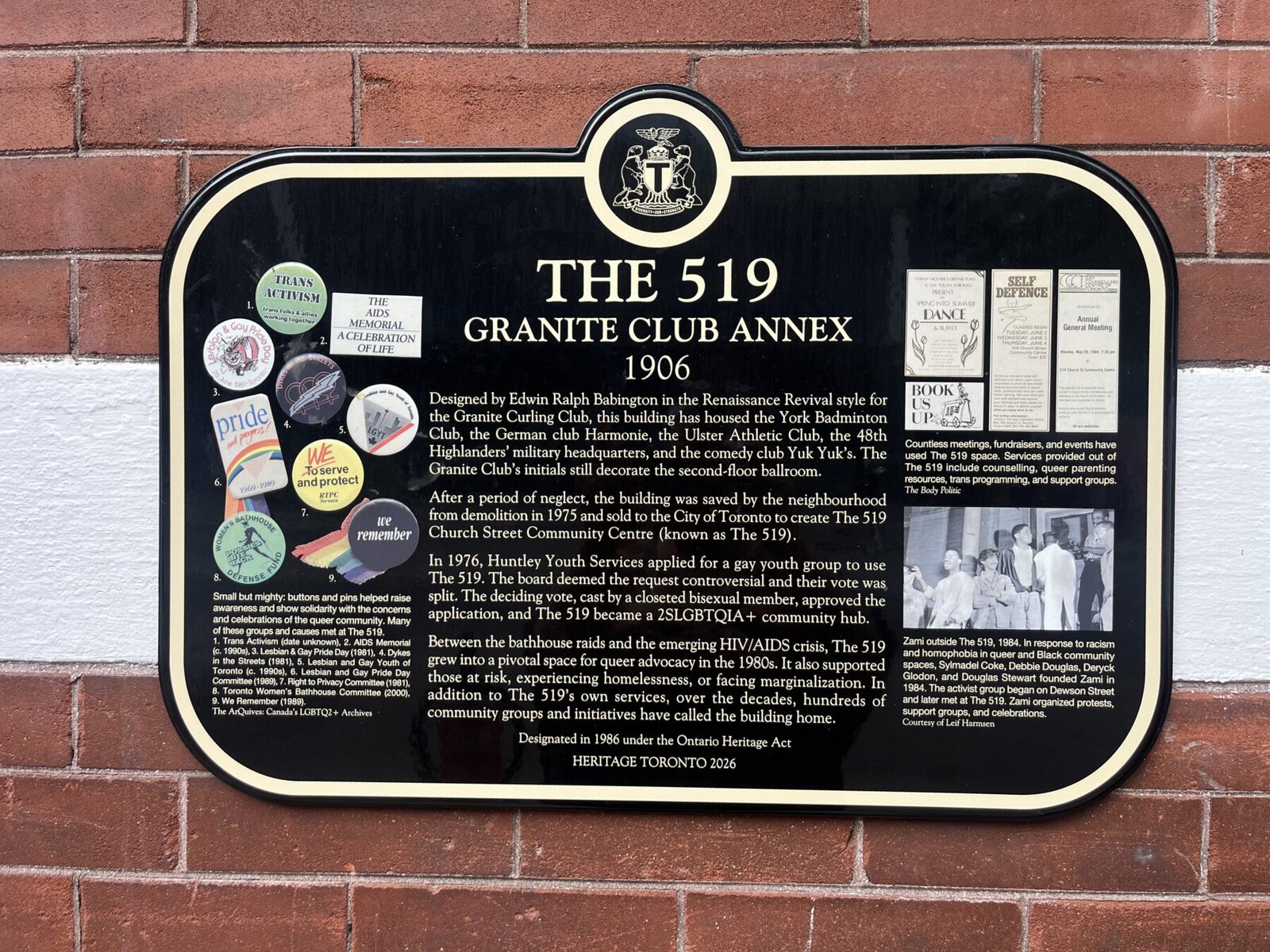
Meanwhile, earlier this year, the organization was honoured with a new Heritage Toronto plaque recognizing its role in the city’s Queer history and the grassroots activism that helped establish it. The unveiling took place on May 19 — a date The 519 has now officially dubbed “519 Day.”
“[The] new plaque includes the existence of The 519 kind of in that long history of the building, and really captures our roots, our grassroots organizing that allowed the 519 to come into being,” Duncan shared.
Green Space: The “funnest” party in town
In addition to being a place for advocacy and community service, The 519 is also the beneficiary of one of Toronto Pride’s biggest parties. Every Pride, Barbara Hall Park – located next to The 519 – transforms into the iconic Green Space Festival, a five-day fundraiser for the centre featuring DJs, drag, dancing, various activations, and all things Queer.
“Green Space really is the funnest party in town,” Duncan laughed.
This year, the festival runs from June 24-28, promising party-goers a free-to-attend event that directly supports the important work done by The 519’s crew. Attendees can find a schedule of programming throughout the festival on the Green Space Festival website.
“All the proceeds that we receive from the bar go directly to supporting the great work that we do in the community, so it’s really the best way that folks can support what we do,” Duncan explained. “Just show up and join us in celebrating.”
Plus, those looking to get in on the action in a calmer environment can do so by attending the Le Royal Drag Brunch at the Yorkville Royal Sonesta Hotel on Saturday, June 27. Running from 11:30 a.m. to 1 p.m., the event features a $35 prix fix menu and performances from Jackie Cox, Diva Beirut, Jada Shada Hudson, and BOA. The brunch is all ages, and all proceeds go to The 519.


