
WHAT Broken Bicycle memorial to Tiananmen Square student uprising
WHERE Hart House Circle, University of Toronto
Why you should check it out
From the footpath that runs alongside it, it’s easy to mistake the Broken Bicycle monument to the 1989 student uprising in Tiananmen Square for a memorial to cyclists killed on Toronto’s streets. You have to walk up closer on the grassy knoll to make out the distinct impressions of the tank treads in the bronze of a crushed, upside-down bike.
Designed by Bruce Parsons and Gu Xiu Hei, the wall sculpture was a gift from the Toronto Association for Democracy in China (TADC) to the University of Toronto – more specifically, the University of Toronto Student Council. The university administration preferred to publicly distance itself from the project, Chinese politics being a charged issue in this country. That is why the monument occupies a wall of the UTSC building – the student union and its building are technically separate from the university.
TADC has been behind fundraising for other monuments dedicated to the uprising, including the Goddess Of Democracy statue unveiled at York University in 2012. That was after a papier-mâché replica that stood in the lobby of the student residents mysteriously went missing just before a visit from a Hong Kong legislator, who was an outspoken critic of the Chinese government.
It’s not the only time that has happened. A bronze plaque accompanying another replica of the statue at the University of Toronto has also inexplicably gone missing – twice – according to a Toronto Star report from 2011.
The UTSC wall sculpture, however, dedicated “to the students and citizens of China… in memory of those who gave their lives for democracy” during the Tiananmen Square uprising has remained firmly in place since it was unveiled in 1992.
Every year since, there has been a ceremony to mark the student uprising that began in April 1989. The protests were sparked by the death of liberal reformer and deposed Communist Party General Secretary Hu Yaobang, a leading voice for political and economic reforms in China. A small group of protestors gathered in the square the day after his death. By the second day, some 100,000 students had showed up to demand political reforms. Many of them rode to the square on their bikes every day to take part in the protests that, at their height, attracted more than half a million people.

The protests would go on for seven weeks and culminate on June 4 with Chinese authorities sending in the tanks. Several hundred protestors would be killed, although other estimates put the number of dead in the thousands. Many more would be arrested. One of the Tiananmen uprising’s best-known participants Lu Decheng, settled as a refugee in Canada. Lu spent nine years in prison for throwing an ink-filled egg at the iconic portrait of Mao Zedong in Tiananmen Square. During a commemoration at a ceremony at the memorial in 2006, he offered on the subject of engagement with China that “It is like drinking poisonous water to quench one’s thirst.”
For many, the Tiananmen uprising marked the last best hope for democratization in China. The student protests continue in Hong Kong more than three decades later, only this time over China’s human rights abuses. A semblance of the market-oriented reforms advocated by Hu have arrived on the Chinese mainland as China has grown into a global economic power. But political reforms are slower in coming. Instead, Western-style capitalism, critics say, has created economic trade-offs over ongoing human rights abuses in China.
Canada remains prominent in that narrative following the arrest of Huawei executive Meng Wanzhou in Vancouver at the behest of the U.S. in 2018.
The pandemic has added another layer to the complicated push for democratization in China, with antipathy over the country’s role in the spread of the coronavirus leading to growing anti-Asian sentiment in Canada and elsewhere.
Sadly, the anti-China backlash may only set back the cause for democracy.
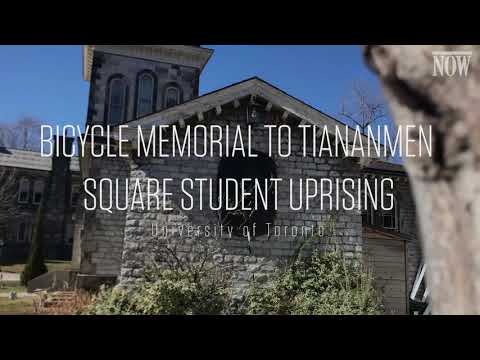
Check out a video about the Tianamen Square memorial below:
Read all of NOW’s Hidden Toronto stories here
Hidden Toronto is a weekly feature exploring the city’s alternative history through contemporary landmarks. Read it online each Sunday or in print every Thursday.


