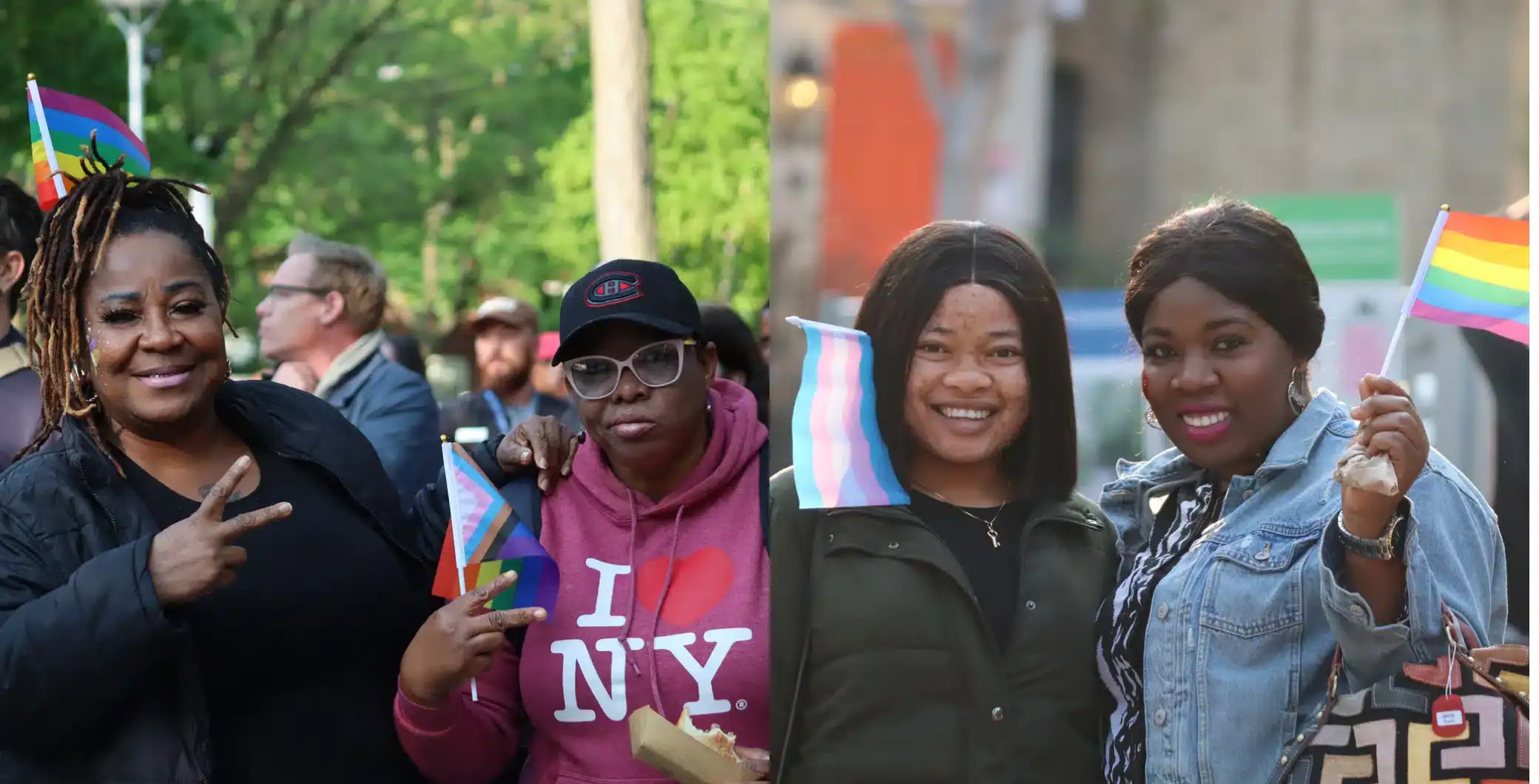
Despite the leadership of Black American activists in the fight for queer rights, (Marsha P. Johnson and Stormé DeLarverie we’re looking at you!) there has been a lack of research into experiences and needs of people in Black queer communities. In Canada, the Enchanté Network is doing something to change that.
The Enchanté Network is a Canada-wide network for 2SLGBTQ+ organizations, offering support through resources like training and microgrants, and creating opportunities for organizations to connect. Enchanté’s new project, Back to Our Roots, is working to fill the gap in Canada’s 2SLGBTQ+ and Black-specific service sectors. Hoping to improve the lives of Black 2SLGBTQ+ people in Canada, the project is exploring the possibility of a national organization focused on Black 2SLGBTQ+ communities.
“The first goal is to explore the possibility of developing a national organization that would be catered to Black, queer, trans and Two-Spirit communities,” Britt Hudson, manager of programs at The Enchanté Network, told Queer & Now.
“The second goal, and this is kind of the scope for the organization, is to understand what the barriers to accessing support to building community are for Black, queer and trans and Two-spirit folks across the country,” Hudson continued.
The project is doing this through various methods, including reviews of previous research, jurisdictional scans of what different services are available across the country, and a survey of over 400 responses from Black 2SLGBTQ+ people in Canada.
The survey looked at housing, employment and education, community and connections, safety, and healthcare, including physical and mental healthcare services.
Hudson shared that 70 per cent of the 400 participants say they have experienced hate crimes. The survey found that 52.6 per cent had experienced hate crimes based on their sexual orientation, gender identity or expression, while 70.2 per cent had experienced a hate crime based on their racial identity.
It also found that 86 per cent of respondents had experienced anti-Black racism in 2SLGBTQ+ spaces.
Hudson shared that when analyzing hate crimes, the organization ensured it was not just looking at police-reported hate crimes.
“We know that Black people tend to have historically negative experiences with the police,” Hudson explained. “So, most times, we don’t want to report hate crimes to the police, because they’re the ones that are causing more harm.”
“We’re trying to capture things like, this happened to you, we believe you, and whether or not you went to those authority figures, we want to be able to understand your experience.”
The project also included community consultations with an additional 70 folks across Canada to look into what they would like a national Black 2SLGBTQ+ organization to accomplish. Their feedback includes a national hub that offers networking, information and support tailored to these communities.
Additionally, people want to see an organization that not only provides services, but works on national coordination, local empowerment, and establishing partnerships with other movements, including human rights organizations, grassroots movements, and Indigenous groups.
Hudson explained that this collaboration would allow the organization to expand beyond bringing Black, queer and trans organizations together, to also offer solidarity across those movements through coalition building.
“Because we see Black folks are extremely diverse and we found within the jurisdictional scan as well that there might be Black services, but those Black services might not be intersectional. There may be queer services, but those services may not be intersectional.”
THE IMPORTANCE OF A BLACK & QUEER-FOCUSED ORGANIZATION
So, if there are organizations dedicated to supporting queer communities, and those focusing on the needs of people in Black communities, why is having an organization founded at the intersection important?
Hudson explained that a lack of specification within an organization leaves the potential for harm. For instance, Black queer people experience racism while accessing a service catering to queer people, or homophobia when accessing services tailored to Black people. Additionally, having a national organization could address the lack of services for Black and queer communities outside of densely populated areas in Canada.
Hudson added that a fair amount of queer services talked about catering to BIPOC folks, but weren’t able to specify what that actually means, which is concerning.
The project also found that these organizations often lack Black representation, leadership, and Black-specific services and support. Hudson says a national organization could support identifying those gaps, and work as an olive branch to meet the needs of existing organizations.
It could also ensure representation during conversations about policy with various levels of government.
“If we’re not in the room, no one’s really speaking for us. The national organization could be in those rooms, and be champions for many of us that don’t have the capacity or the time to be able to do that work.”
FIRST-OF-ITS KIND NATIONAL BLACK 2SLGBTQI+ FUTURES SUMMIT
Following all this work, Hudson shared feelings of hope.
“The most amazing part was the dreaming process. Endless consultation, being able to not just hear what folks’ experiences are now but also to be able to capture what hope looks like for them, [and] what a future looks like for them.”
That hope will be celebrated during an upcoming conference in Ottawa. From March 1 to 3, the first-of-its-kind Back to Our Roots project culminates in the National Black 2SLGBTQI+ Futures Summit, where over 150 people will gather in the nation’s capital to learn more about the project and what a possible national organization could look like.
“We’re not just looking at a report to say like, this is what our experiences are right now, but we’re getting into the room with folks from across the country. Changemakers, and leaders, people that are doing the work from all the way from B.C. to P.E.I., we’re all coming together, to envision and to say, we know we have a voice. We want to be heard, we deserve to be heard,” Hudson told Queer & Now.
“We deserve to strategize together and to envision a Canada where Black queer and trans people are not on the extremes of the margin. Where we’re at the table, and where our communities are met,” Hudson explained.
While summit events taking place on March 2 and 3 are exclusively for Black transgender and queer people, The Back to Our Roots Kiki Ball being held on March 1 is open to allies.
Hudson explained that having a kiki ball was significant due to the history of ballroom culture, which was created by people of colour who were excluded from the drag scene.
READ MORE: Toronto World AIDS Day Ball aims to raise awareness about HIV and have fun doing it
“The other piece is that they created community and they created houses, they created families, especially for folks that had no other place to turn to,” Hudson explained. “So, when we’re thinking of the mandate, or like the ethics of this organization, I think about how ballroom culture has been that place for so many people.”