What to know
- Toronto saw two new rapid transit lines in recent months – the Line 5 and the Line 6 Light Rail Transit.
- The city’s transit network, when put into context with its population, raises the question: Is it enough?
- Transit riders tell Now Toronto the city is doing enough for their daily commute.
- An infrastructure expert tells Now Toronto that while there is room for improvement, there is also plenty of optimism.
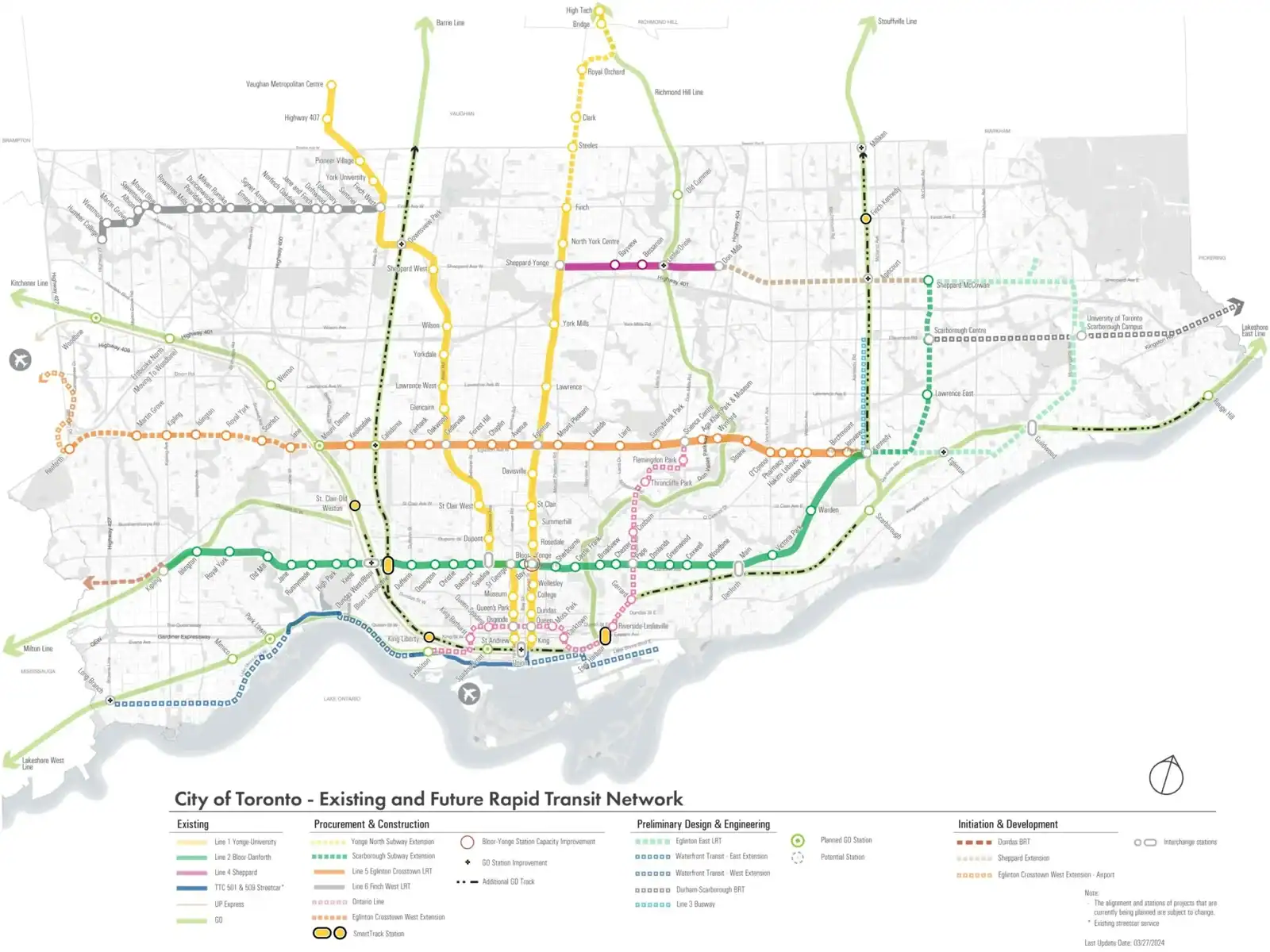
As of today, Toronto has five rapid transit lines and 11 streetcar routes. Now Toronto asked residents and an expert: Is that enough?
Toronto unveiled two new rapid transit lines in the last three months – after no new lines had been constructed since 2002. In fact, the city’s Line 3 (a.k.a. Scarborough RT) was permanently shut down in 2023, to be replaced by the extension of Line 2, which recently celebrated its 60th anniversary.
Read More
- ‘A long time coming,’ Hundreds of TTC riders attend Finch West LRT grand opening
- First day of Eglinton LRT: What riders are saying and what Mayor Olivia Chow is promising
- Rest in Peace to the Scarborough RT, a look at the transit line’s life
- 60 years of Line 2: Key moments in Toronto’s Bloor-Danforth subway line’s history
However, that’s not entirely fair to the city, according to Matti Siemiatycki, director of Infrastructure Institute and host of Good For Cities Podcast.
“I think that framing underappreciates what has gone on here,” Siemiatycki tells Now Toronto.
And he’s right. From 2002 to the opening of Finch West LRT, the city has seen the opening of the St. Clair streetcar line, the extension of Line 1 all the way up to Vaughan, and the Union Pearson Express line. Not to mention its ever-growing network of GO buses.

“The level of ambition around transit projects right now and the desire to build quickly is a positive thing,” Siemiatycki says.
“We’re investing – we probably have the biggest transit investment portfolio (certainly in North America) at the moment.”
In 2021, the federal government announced it would provide $10.4 billion for four transit projects in the Greater Toronto Area (GTA): Ontario Line, Eglinton Crosstown West Extension, Yonge North Subway Extension, and the Scarborough Subway Extension. Not to mention the Ford government’s $70 billion commitment to “build and expand public transit”.
Ontario Line construction has hit another big milestone, with work now underway to build four stations on the line’s eastern end and connect them with a three kilometre elevated guideway.
— Doug Ford (@fordnation) February 18, 2026
The Ontario Line is at the centre of our $70 billion plan to build and expand public… pic.twitter.com/h3DTcrwQw4
Read More
For the most part, the city’s transit riders have little complaint.
“As far as I’ve lived here, it’s been good enough for me,” Omar tells Now Toronto. “I’ve never had any incidents over them being too crowded. … Can do with a little improvement, but it’s not too bad.”
“Sometimes when there is construction on the roads, it’s sometimes hard, but yeah, it’s good,” Sison tells Now Toronto.
When comparing its transit map side-by-side with that of Munich’s, however, their perspective shifted. Munich is the third-largest city in Germany with a population of 1.5 million as of 2024 – half of the 3 million reported in the City of Toronto as of July 2022.
“Wow, it’s huge,” Josefa, looking at Munich’s transit map of its U- and S-Bahn and trams, tells Now Toronto
But Siemiatycki, who visited Munich last summer, says transit maps do not tell the full story.
“They might have a lot of lines on the map, but I did not find their system intuitive and very easy to use,” he says.
In fact, he sat on the train out of the airport as it broke down during transit thinking to himself, ‘This is a very Toronto thing to happen.’
“It’s easy to be pessimistic and critical of Toronto’s transit system… But it is also telling that many people who come here from other cities comment on how effective and efficient the transit system is.”
Omar, who has also taken the transit system in Munich, had a slightly better experience on it than Siemiatycki did, calling it a “world’s way better” than Toronto.
Where is GTA’s transit infrastructure falling short?
For the most part, Toronto is on the right track. But has it kept pace with the population growth?
“Absolutely not,” Siemiatycki says.
A key demographic that’s often overlooked in discussions of infrastructure development: the outer suburbs.
“Places like Milton, Ajax, Durham Region, Peel, Brampton. … You have to think of transit as a network, and the network as a whole has not kept pace.”
What may contribute to this oversight may be the politicization of major projects in the province.
“We often have projects that stop and start; that change when the political administration changes,” Siemiatycki explains.
“One of the things that happens here in Canada is that everyone needs their project to go first because they’re concerned that if their project doesn’t go first, the policy or the funding is going to change.”
This “see-sawing” or project selection, according to Siemiatycki, places a greater burden on the current administration to prioritize certain developments over others, not to mention incur administrative costs in the long run.
Another factor that plays into the city’s slow development according to Siemiatycki: the cost of building.
“We’ve become one of the most expensive places to build a public transit per kilometer,” Siemiatycki says.
“That means that, as much as we’re trying to be ambitious, we’re getting less bang for our buck than in many other places.”
How can the city’s transit system improve?
According to Siemiatycki, transit improvement is not just about unveiling new lines and digging new tunnels; it’s about keeping what already exists operating smoothly.
“There is enthusiasm and excitement around the building boom of transit,” he says.
“The same attention, focus, and resources have not always been there for the operations and the maintenance.”
Just last month, several Toronto Transit Commission (TTC) stations faced barriers to their accessibility, with several elevators going out of service. At the time, a TTC spokesperson told Now Toronto that repair work can take place as late as May in some of those cases.
The malfunction happened as calls grew for the commission to improve its accessibility.
Read More
The region’s GO Transit had also been under fire, after a train’s derailment early February caused subsequent service disruptions in the days that followed.
Read More
“The day-to-day frustrations are real,” Siemiatycki says.
“The go-slow zones, the number of reliability issues, the number of times it breaks down, the number of times there are issues at track level… Those are starting to wear on people’s confidence in it.”
Toronto transit riders continue to show up for the city’s efforts
However, something that stands out for Siemiatycki about Toronto’s transit culture is that riders show up to support the milestones despite the turbulence.
Hundreds lined up for the grand opening of the Finch West Line 6 LRT in December as snow fell sideways, some as early as 2 a.m. Dozens also showed up bright and early for the first day of the Eglinton Crosstown LRT. There were no official celebrations the way there had been for Line 6, but they showed up just to check it out.
Read More
“I think that points to something that bodes well – that we have a constituency in a community of people that are willing to invest their money and their future resources into building a better city.”